
DS Group Solar (Solaxio DS Energy Pvt. Ltd.) | dsgroupsolar.in | संपर्क: 9584693271

बिजली की शक्ति और उसके खतरे


आज के आधुनिक भारत में बिजली केवल एक सुविधा नहीं, बल्कि जीवन की अनिवार्यता बन चुकी है। घर में पंखा, फ्रिज, AC से लेकर कारखाने की मशीनें, अस्पताल के उपकरण और सोलर पावर प्लांट तक, हर जगह विद्युत ऊर्जा की जरूरत है। भारत सरकार के MNRE (Ministry of New and Renewable Energy) के आंकड़ों के अनुसार, मई 2026 तक भारत की कुल स्थापित सौर ऊर्जा क्षमता लगभग 157 GW तक पहुंच चुकी है और भारत विश्व में तीसरा सबसे बड़ा नवीकरणीय ऊर्जा देश बन गया है।

लेकिन बिजली की यह शक्ति जितनी उपयोगी है, उतनी ही खतरनाक भी हो सकती है यदि इसका उपयोग सही मानकों के बिना किया जाए। गलत वायरिंग, खराब अर्थिंग, ओवरलोडिंग और सुरक्षा उपकरणों की अनदेखी हर साल हजारों लोगों की जान ले लेती है।


34+

मौतें हर दिन (NCRB)

12,500+

मौतें हर साल

1 लाख+

10 साल में मौतें

400%

वज्रपात वृद्धि (2019-25)


स्रोत: NCRB (National Crime Records Bureau) और CROPC Annual Lightning Report 2024-25

Electricity Code क्या होता है?


Electricity Code विद्युत स्थापना (Installation), संचालन (Operation) और रखरखाव (Maintenance) से संबंधित नियमों एवं मानकों का एक व्यवस्थित समूह है। यह कोई एक किताब नहीं, बल्कि कई सरकारी और तकनीकी नियमावलियों का सामूहिक नाम है जो यह सुनिश्चित करती हैं कि विद्युत प्रणाली सुरक्षित, विश्वसनीय और कानूनी रूप से अनुपालन वाली हो।


भारत में लागू प्रमुख कानून और मानक


1. Electricity Act, 2003: यह भारत का मुख्य विद्युत कानून है जो विद्युत उत्पादन, पारेषण, वितरण और व्यापार को नियंत्रित करता है।

2. Central Electricity Authority (CEA) Regulations, 2023: CEA ने जून 2023 में नवीन सुरक्षा विनियम जारी किए जो सोलर और नवीकरणीय ऊर्जा प्रणालियों पर विशेष ध्यान देते हैं।

3. IS 3043 (BIS): भारतीय मानक ब्यूरो (BIS) का यह मानक अर्थिंग सिस्टम के डिजाइन और स्थापना की मार्गदर्शिका है।

4. IS 60898 (MCB) और IS 12640 (RCCB): सर्किट ब्रेकरों के लिए BIS मानक।

5. National Electrical Code (NEC): CPWD द्वारा भवन निर्माण में विद्युत स्थापना के लिए दिशानिर्देश।


Electricity Code के मुख्य उद्देश्य

  • मानव जीवन की सुरक्षा और बिजली के झटकों से बचाव
  • विद्युत अग्निकांड और दुर्घटनाओं की रोकथाम
  • महंगे उपकरणों और यंत्रों की सुरक्षा
  • ऊर्जा दक्षता और बिजली नेटवर्क की विश्वसनीयता
  • DISCOM (बिजली वितरण कंपनियों) के साथ कानूनी अनुपालन

भारत में विद्युत दुर्घटनाओं की भयावह वास्तविकता


भारत में विद्युत सुरक्षा की स्थिति अत्यंत चिंताजनक है। National Crime Records Bureau (NCRB) के आंकड़ों के अनुसार, पिछले दशक (2011-2020) में लगभग 1.1 लाख लोगों की मौत बिजली के करंट से हुई। यह आंकड़ा 2022 में बढ़कर 12,492 और 2023 में लगभग 12,500 प्रति वर्ष हो गया। सरल भाषा में कहें तो भारत में हर दिन औसतन 34 लोग बिजली के करंट से मरते हैं।

दुर्घटनाओं के प्रमुख कारण


A. बिजली का झटका (Electric Shock)

खराब या ढीले तार, अर्थिंग की कमी, नमी में विद्युत उपकरणों का उपयोग और बिना इंसुलेशन के तारों को छूना बिजली के झटके के मुख्य कारण हैं। 230 वोल्ट AC पर महज 100 मिलीएम्पियर की धारा भी मानव हृदय के लिए घातक हो सकती है।


B. विद्युत आग (Electrical Fire)

भारत में हर साल 7,000 से अधिक आग से होने वाली मौतों में एक बड़ा हिस्सा विद्युत शॉर्ट सर्किट से होता है। ओवरलोडेड वायरिंग, ढीले कनेक्शन, पुराने और निम्न गुणवत्ता के तार, और गलत फ्यूज का उपयोग विद्युत आग के प्रमुख कारण हैं।


C. वज्रपात (Lightning Strike)

भारत में मानसून के दौरान वज्रपात से होने वाली मौतें चिंताजनक रूप से बढ़ रही हैं। CROPC (Climate Resilient Observing Systems Promotion Council) की Annual Lightning Report 2024-25 के अनुसार, 2019 से 2025 के बीच भारत में बिजली गिरने की घटनाओं में लगभग 400% की वृद्धि हुई है। मध्यप्रदेश में 2014 से 2025 के बीच 3,496 लोगों की मौत वज्रपात से हुई जो देश में सबसे अधिक है। इसके बाद बिहार (3,041) और हिमाचल प्रदेश (2,923) का नंबर आता है।


चेतावनी: एक सामान्य वज्रपात में लगभग 30 करोड़ वोल्ट बिजली होती है जो तत्काल मृत्यु या गंभीर जलन का कारण बन सकती है।

सोलर प्लांट, खुले खेत, ऊंची इमारतें और बिना संरक्षण के स्थान वज्रपात के प्रति अत्यंत संवेदनशील होते हैं।

सही वायरिंग का महत्व: आपकी विद्युत प्रणाली की रीढ़


विद्युत प्रणाली में सबसे महत्वपूर्ण और बुनियादी घटक उसकी वायरिंग होती है। गलत वायरिंग न केवल बिजली की बर्बादी करती है बल्कि आग और दुर्घटनाओं का सबसे बड़ा कारण भी बनती है। सदैव ISI (Indian Standards Institution) प्रमाणित तार का उपयोग करें क्योंकि ये BIS द्वारा परीक्षित होते हैं।


केबल का चयन: कौन सी वायर कहां लगाएं?


केबल साइज उपयोग करंट क्षमता मानक
1.5 sqmm लाइट, पंखे, छोटे उपकरण लगभग 13A तक IS 694 / BIS
2.5 sqmm पावर सॉकेट, TV, कम्प्यूटर लगभग 20A तक IS 694 / BIS
4 sqmm AC, वॉटर हीटर, भारी लोड लगभग 27A तक IS 694 / BIS
6 sqmm बड़े AC, इंडस्ट्रियल पंप लगभग 36A तक IS 1554 / BIS
10+ sqmm मेन सप्लाई, मोटर, सबमेन 50A और उससे अधिक IS 1554 / BIS


वायरिंग में ध्यान देने योग्य महत्वपूर्ण बातें

  • हमेशा ISI/BIS प्रमाणित केबल का उपयोग करें जिस पर IS 694 या IS 1554 की मुहर हो।
  • सोलर सिस्टम में DC वायरिंग के लिए UV Resistant Solar Cable अनिवार्य है क्योंकि सामान्य तार धूप में जल्दी खराब हो जाते हैं।
  • तांबे (Copper) के तार एल्युमिनियम की तुलना में अधिक सुरक्षित और टिकाऊ होते हैं।
  • प्रत्येक सर्किट की लोड कैलकुलेशन करके सही साइज का तार चुनें। कभी भी उससे छोटा तार न लगाएं।
  • तारों को उचित नाली (Conduit) में बिछाएं और नमी से बचाएं, विशेषकर बाहरी स्थानों पर।

अर्थिंग (Earthing): विद्युत सुरक्षा की आत्मा


अर्थिंग वह प्रक्रिया है जिसके द्वारा विद्युत उपकरणों के धात्विक हिस्सों को जमीन (Earth) से जोड़ा जाता है। यह विद्युत प्रणाली का सबसे महत्वपूर्ण सुरक्षा उपाय है जो BIS के IS 3043-2018 (Code of Practice for Earthing) द्वारा नियंत्रित होता है।

अर्थिंग क्यों जरूरी है?


जब किसी उपकरण में खराबी होती है और विद्युत धारा उसके धातु के आवरण (Metal Casing) में आ जाती है, तो बिना अर्थिंग के उस उपकरण को छूने वाले व्यक्ति को करंट लग सकता है और मृत्यु भी हो सकती है।

अर्थिंग इस करंट को सुरक्षित रूप से जमीन में भेज देती है जिससे MCB या RCCB तुरंत सप्लाई काट देता है।

अर्थिंग वोल्टेज सर्ज और लाइटनिंग के प्रभाव को भी कम करती है और इलेक्ट्रॉनिक उपकरणों की रक्षा करती है।


अर्थिंग के मानक: IS 3043-2018

BIS का IS 3043-2018 मानक निम्न प्रावधान करता है:

  • Earth Electrode की न्यूनतम गहराई: Rod-type electrode के लिए कम से कम 2.5 मीटर।
  • Earth Resistance का मान: आदर्श रूप से 1 ओम से कम, और किसी भी स्थिति में 5 ओम से अधिक नहीं होना चाहिए।
  • सोलर प्लांट के लिए: 10 kW और उससे बड़े सिस्टम में DC Side, AC Side और Lightning Arrestor के लिए अलग-अलग तीन Earth Pit अनिवार्य हैं।
  • सामग्री: तांबे (Copper) की या Copper-Bonded Steel Rod का उपयोग करें जो जंग प्रतिरोधी हो।
  • Earthing का परीक्षण प्रत्येक 6 से 12 माह में करें और रिकॉर्ड बनाए रखें।


सोलर प्लांट में अर्थिंग: CEA 2023 नियम

Central Electricity Authority (CEA) के जून 2023 में जारी नए विनियमों के अनुसार सोलर प्लांट में निम्न अर्थिंग अनिवार्य है:

  • Module Structure Earthing: सभी सोलर पैनल की धातु संरचना को अर्थ से जोड़ना।
  • Inverter Earthing: इन्वर्टर का आवरण और DC Bus को उचित रूप से अर्थ करना। Flexible Braided Copper Wire का उपयोग अनिवार्य।
  • Lightning Arrestor Earthing: वज्रपात से बचाव के लिए लाइटनिंग अरेस्टर की अलग Earth Pit।
  • Junction Box Earthing: सभी Junction Box और ACDB/DCDB के धातु आवरण को अर्थ करना।

MCB, MCCB और RCCB: विद्युत सुरक्षा के तीन रक्षक


विद्युत सुरक्षा में Circuit Breakers की भूमिका अत्यंत महत्वपूर्ण है। ये उपकरण स्वतः (Automatically) असामान्य विद्युत परिस्थितियों में सप्लाई काट देते हैं और दुर्घटना से बचाते हैं।

A. MCB (Miniature Circuit Breaker)

MCB एक छोटा स्वचालित स्विच है जो ओवरलोड और शॉर्ट सर्किट से सर्किट की रक्षा करता है। BIS मानक IS 60898 (IEC 60898-1 पर आधारित) के अंतर्गत MCB घरेलू और छोटे व्यावसायिक प्रतिष्ठानों के लिए उपयुक्त है।

  • उपलब्ध क्षमता: 6A से 125A तक
  • प्रकार: Type B (घरेलू लाइट और पावर), Type C (मोटर और इंडक्टिव लोड), Type D (भारी औद्योगिक मशीनें)
  • उपयोग: घरों में Lighting Circuit और Power Socket Circuit में
  • लाभ: पुराने Rewirable Fuse की तुलना में अधिक सुरक्षित, बार-बार उपयोग योग्य

B. MCCB (Moulded Case Circuit Breaker)

MCCB बड़े औद्योगिक और व्यावसायिक प्रतिष्ठानों के लिए उपयोग किया जाने वाला Circuit Breaker है। यह IEC 60947-2 मानक के अनुरूप होता है और 100A से 2500A तक की क्षमता में उपलब्ध होता है।

  • उपयोग: कारखानों में Main Distribution Board, बड़े AC और मोटर के संरक्षण में
  • विशेषता: Thermal और Magnetic दोनों प्रकार की Protection, Adjustable Setting
  • Accessories: Auxiliary Contact, Shunt Trip, Under Voltage Release जोड़े जा सकते हैं
  • Short Circuit Capacity: MCB से बहुत अधिक, बड़े Fault Currents को संभालने में सक्षम

C. RCCB (Residual Current Circuit Breaker)

RCCB सबसे महत्वपूर्ण जीवन रक्षक उपकरण है। यह करंट लीकेज (Earth Fault Current) को पकड़ता है जिसे MCB नहीं पकड़ सकता। BIS मानक IS 12640 Part 1 के अनुसार RCCB भारत में उपयोग के लिए आवश्यक है।

  • कार्यसिद्धांत: यदि Phase Current और Neutral Current में 30mA या उससे अधिक का अंतर आता है, तो RCCB 25-40 मिलीसेकंड में सप्लाई काट देता है।
  • सेंसिटिविटी: मानव सुरक्षा के लिए 30mA RCCB सबसे उपयुक्त है।
  • उपयोग: गीले स्थान (बाथरूम, किचन, बाहर), सोलर प्लांट और जहां लोगों का संपर्क उपकरणों से होता है।
  • महत्वपूर्ण: RCCB Overload या Short Circuit से सुरक्षा नहीं करता। इसलिए MCB के साथ RCCB का संयोजन करें।


सलाह: RCCB और MCB के संयुक्त कार्य के लिए RCBO (Residual Current Circuit Breaker with Overcurrent Protection) का उपयोग करें।

सोलर सिस्टम में: DC Side पर DC RCCB और AC Side पर Standard RCCB का उपयोग करें।

हर 3 महीने में Test Button दबाकर RCCB का परीक्षण करें और सुनिश्चित करें कि वह ठीक से Trip हो रहा है।


Surge Protection Device (SPD): इलेक्ट्रॉनिक उपकरणों का रक्षाकवच


आधुनिक सोलर इन्वर्टर, स्मार्ट मीटर और इलेक्ट्रॉनिक उपकरण अत्यंत संवेदनशील Semi-Conductor आधारित Components से बने होते हैं। एक मिलीसेकंड का Voltage Spike इन्हें स्थायी रूप से नष्ट कर सकता है। SPD इन्हीं खतरों से बचाने के लिए डिजाइन किए गए हैं।


SPD क्यों जरूरी है?

  • वज्रपात (Direct या Indirect Lightning Strike) से उत्पन्न उच्च वोल्टेज सर्ज से सुरक्षा।
  • पावर ग्रिड में होने वाले Voltage Transients और Switching Surges से बचाव।
  • Inverter, Charge Controller, MPPT और अन्य Solar Electronics की दीर्घकालिक सुरक्षा।
  • SPD IEC 61643-11 (AC Systems) और IEC 61643-31 (DC PV Systems) मानकों के अनुरूप होने चाहिए।


सोलर प्लांट में SPD की स्थापना

  • DC Side SPD: Solar Panel और Inverter के बीच DC Surge Protector अनिवार्य।
  • AC Side SPD: Inverter के आउटपुट और Grid Connection के बीच AC SPD लगाएं।
  • Type 1 SPD: बड़े इंस्टॉलेशन में Main DB के प्रवेश बिंदु पर (Lightning Current Arrester)।
  • Type 2 SPD: Sub DB और उपकरण स्तर पर Voltage Surge Protector।

Lightning Protection System: वज्रपात से बचाव का विज्ञान


भारत में वज्रपात अब सबसे घातक प्राकृतिक आपदा बन चुकी है। CROPC की रिपोर्ट के अनुसार, 2019 से 2025 के बीच बिजली गिरने की घटनाओं में 400% की भारी वृद्धि हुई है जो जलवायु परिवर्तन का परिणाम है। अप्रैल 2025 में मार्च-अप्रैल की अवधि में 162 मौतें हुईं जो पिछले वर्ष की तुलना में 184% अधिक थीं।

Lightning Protection System (LPS) के घटक

1. Air Terminal (Lightning Rod)

यह धातु की नुकीली छड़ होती है जो इमारत या स्ट्रक्चर की सबसे ऊंची जगह पर लगाई जाती है। यह वज्रपात को अपनी ओर आकर्षित करती है और सुरक्षित रास्ते से जमीन में पहुंचाती है।

2. Down Conductor (Conductor Cable)

Air Terminal से Ground Earth Pit तक जोड़ने वाला मोटा धातु का तार। IS 2309 मानक के अनुसार यह आमतौर पर 25 sqmm से 50 sqmm का GI या Copper Strip होता है।

3. Earth Electrode (Ground Pit)

जमीन में गड्ढा खोदकर लगाई गई Earth Pit जहां Lightning का विद्युत प्रवाह सुरक्षित रूप से जमीन में विलीन हो जाता है। इसका Resistance 5 ओम से कम होना चाहिए।


सोलर प्लांट के लिए Lightning Protection

CEA Safety Regulations 2023 के Chapter X के अनुसार, सभी सोलर पावर प्लांट में Lightning और Overvoltage Protection का प्रावधान अनिवार्य है। इसमें शामिल हैं:

  • PV Array के ऊपर और आसपास Lightning Masts/Rods की उचित Placement।
  • Module Structure को Earthing Grid से जोड़ना ताकि Lightning Current सुरक्षित रूप से Dissipate हो।
  • SPD और Lightning Arrestor दोनों का संयोजन एक Complete Protection System बनाता है।
  • Equipotential Bonding: सभी धातु संरचनाओं को एक समान Potential पर बनाए रखना।

सोलर प्लांट में Electricity Code: CEA 2023 अनुपालन


भारत में सौर ऊर्जा क्षेत्र तेजी से बढ़ रहा है। MNRE के अनुसार FY 2025-26 में भारत ने रिकॉर्ड 44-45 GW सोलर क्षमता जोड़ी जो पिछले वर्ष से 106% अधिक है। रूफटॉप सोलर सेगमेंट में 8.7 GW की वृद्धि हुई जो 69% की सालाना बढ़ोतरी है। PM Surya Ghar: Muft Bijli Yojana के तहत 26 लाख से अधिक घरों को कवर किया गया है।

इतनी तेज गति से बढ़ते सोलर इंस्टॉलेशन के साथ सुरक्षा मानकों का पालन अत्यंत महत्वपूर्ण हो गया है।

DC Side (सोलर पैनल से Inverter तक)

आवश्यक Equipment:

  • UV Resistant Solar Cable (PV1-F या H1Z2Z2-K): सामान्य तार की तुलना में 25 साल तक टिकाऊ।
  • MC4 Connectors: IP67 रेटेड Weatherproof Connectors जो नमी और धूल से सुरक्षित।
  • DC Isolator (Disconnect Switch): Inverter की Servicing के समय DC सप्लाई काटने के लिए।
  • String Combiner Box / DCDB: Multiple Strings को Combine करने और Fuse Protection के लिए।
  • DC SPD: Solar Array से आने वाले Voltage Surges को Ground करने के लिए।

AC Side (Inverter से Grid तक)

आवश्यक Equipment:

  • ACDB (AC Distribution Box): AC Side Protection और Monitoring के लिए।
  • AC SPD: Grid-side Voltage Surges से Inverter और उपकरणों की सुरक्षा।
  • MCCB/MCB: Overcurrent और Short Circuit Protection।
  • Energy Meter: DISCOM-approved Bidirectional Smart Meter Net Metering के लिए।
  • Anti-Islanding Protection: Grid Failure के समय Inverter का स्वतः बंद होना (CEA अनिवार्य)।

Net Metering Compliance

DISCOM से Net Metering Approval के लिए निम्न दस्तावेज और अनुपालन आवश्यक है:

  • Single Line Diagram (SLD): पूरी Electrical System का नक्शा।
  • Commissioning Report और Safety Declaration।
  • ALMM (Approved List of Models and Manufacturers) Listed Solar Panels: जून 2026 से Non-DCR Panels पर प्रतिबंध लागू।
  • CEA/BIS Certified Inverter और अन्य Equipment।
  • Test Reports: Earthing Resistance, Insulation Resistance और I-V Curve Testing।

घरेलू सोलर इंस्टॉलेशन में विशेष सावधानियां


जब आप अपने घर की छत पर सोलर सिस्टम लगवाते हैं तो Electricity Code का पालन और भी आवश्यक हो जाता है क्योंकि यहां परिवार के सदस्य, बच्चे और बुजुर्ग भी रहते हैं।

इंस्टॉलेशन से पहले

  • Roof Load Capacity: एक Standard Solar Panel का वजन 20-25 KG होता है। सुनिश्चित करें कि आपकी छत इस भार को वहन कर सके।
  • Structural Assessment: विशेषकर पुरानी इमारतों में Structural Engineer से सलाह लें।
  • Water Proofing: Panel के नीचे छत में पानी न घुसे, इसके लिए उचित Waterproofing करें।
  • Shadow Analysis: दिन में 9 AM से 3 PM तक Panel पर कोई छाया न पड़े।

इंस्टॉलेशन के दौरान

  • केवल ALMM Listed और BIS Certified Solar Panels का उपयोग करें।
  • CEA और DISCOM Approved Inverter चुनें जिसमें Anti-Islanding Protection हो।
  • UV Resistant Solar Cable का उपयोग करें और सभी तारों को Conduit में बिछाएं।
  • Earthing अनिवार्य रूप से IS 3043 के अनुसार करें और Earth Resistance Test Report लें।
  • SPD और Lightning Arrestor लगाएं, खासकर मानसून प्रभावित क्षेत्रों में।


इंस्टॉलेशन के बाद

  • Net Metering के लिए DISCOM को आवेदन करें और Bidirectional Smart Meter लगवाएं।
  • System Commissioning Report और Test Certificates सुरक्षित रखें।
  • Remote Monitoring System से उत्पादन और Performance Track करें।
  • Annual Maintenance Contract (AMC) के तहत नियमित Panel Cleaning और Inspection करवाएं।

Commercial और Industrial (C&I) Solar Projects में सुरक्षा


व्यावसायिक और औद्योगिक सोलर प्रोजेक्ट में अत्यधिक उच्च क्षमता और जटिल विद्युत प्रणालियां होती हैं। यहां Electricity Code का पालन और भी कड़ाई से आवश्यक है।

LT और HT Protection

  • Low Tension (LT) Panel: MCCBs, Busbars और Metering Panels का उचित डिजाइन।
  • High Tension (HT) System (33kV/11kV): VCB, SF6 Breakers और Protective Relays।
  • Transformer Protection: Buchholz Relay, Oil Temperature Relay और Winding Temperature Relay।
  • Differential Protection: बड़े Transformers में Earth Fault और Short Circuit से सुरक्षा।

Advanced Earthing System

  • Mesh Earthing Grid: पूरे Plant क्षेत्र में धातु की जाली (Mesh) बिछाकर समान Potential बनाना।
  • Step Potential और Touch Potential: IEEE 80 मानक के अनुसार Design जो Plant के अंदर चलने वाले लोगों के लिए सुरक्षित हो।
  • Chemical Earth Pits: उच्च मृदा प्रतिरोधकता वाले स्थानों पर Chemical Treatment Earth Electrodes।

Energy Monitoring और SCADA System

बड़े Commercial/Industrial Installations में Real-Time Monitoring अनिवार्य होती जा रही है:

  • IoT आधारित Remote Monitoring System (RMS) से 24×7 उत्पादन, वोल्टेज, करंट और Temperature Track करें।
  • SCADA (Supervisory Control and Data Acquisition): पूरे Plant के Centralized Control के लिए।
  • Preventive Maintenance Schedule: प्रत्येक 6 माह में Thermographic Survey, Earthing Test और Insulation Test।

DS Group Solar: आपका विश्वसनीय ऊर्जा साझेदार


Solaxio DS Energy Pvt. Ltd. (DS Group Solar) छत्तीसगढ़ के पेंड्रा रोड स्थित एक प्रतिष्ठित Solar EPC (Engineering, Procurement and Construction) कंपनी है। सौर ऊर्जा के क्षेत्र में वर्षों के अनुभव के साथ DS Group Solar ने 3,170 MW से अधिक परियोजनाएं सफलतापूर्वक कमीशन की हैं और 306 MW से अधिक परियोजनाएं वर्तमान में प्रगति पर हैं।

हमारी उपलब्धियां


3,170+ MW

Commissioned Projects

306+ MW

Ongoing Projects

3.9 MT/yr

CO2 Emission Saved


DS Group Solar की संपूर्ण सेवाएं

DS Group Solar “Loan Se Lekar ON Tak Hamari Jimmedari” के सिद्धांत पर कार्य करती है। इसका अर्थ है कि सोलर प्रोजेक्ट की वित्तीय योजना से लेकर इंस्टॉलेशन के बाद की देखभाल तक हर चरण में DS Group Solar आपके साथ है।


तकनीकी सेवाएं सहायता सेवाएं
Site Survey और Shadow Analysis Financial Support और Loan Facilitation
Load Analysis और System Design Net Metering Approval और DISCOM Coordination
Structure Engineering Design Remote Monitoring और IoT Integration
ALMM/BIS Certified Material Supply Solar Panel Cleaning Solutions
Earthing और Lightning Protection System Battery Energy Storage System (BESS)
Professional Installation और Testing After Sales Support और AMC
Inspection Checklist और Commissioning EV Charging Station Setup
PM KUSUM Scheme Implementation Training और Technical Workshops


DS Group Solar क्यों चुनें?

  • ALMM और BIS Certified उत्पादों का उपयोग जो सरकारी मानकों के अनुरूप हैं।
  • Senior Expert Team जो CEA 2023 के नवीनतम Regulations के अनुसार कार्य करती है।
  • Rooftop से Megawatt Scale तक Ground Mounted, Floating और Rooftop Projects।
  • PM KUSUM Scheme, PM Surya Ghar Yojana और DISCOM Subsidy में सहायता।
  • JSW Steel जैसे प्रतिष्ठित Partners के साथ Quality Material Supply।
  • SCADA और IT आधारित Remote Monitoring System से 24×7 Performance Tracking।

संपर्क करें


DS Group Solar (Solaxio DS Energy Pvt. Ltd.)

GST: 22ABPCS3190Q1ZN

पता: SH 8 Dubatiya, Post Kudkai, Pendra Poad, Bilaspur, Chhattisgarh, Pin 495119

फोन: 9584693271 / 011-6926-9583

ईमेल: contact@dsgroupsolar.in

वेबसाइट: dsgroupsolar.in


सुरक्षित बिजली, सुरक्षित परिवार


Electricity Code केवल एक कानूनी आवश्यकता नहीं बल्कि आपके परिवार, व्यवसाय और भविष्य की सुरक्षा का आधार है। NCRB के आंकड़े बताते हैं कि हर दिन 34 से अधिक लोग बिजली के करंट से मरते हैं। यह संख्या तब घट सकती है जब हम सभी सही वायरिंग, उचित अर्थिंग, सुरक्षा उपकरण और मानक इंस्टॉलेशन का पालन करें।

भारत तेजी से सौर ऊर्जा की ओर बढ़ रहा है। FY 2025-26 में रिकॉर्ड 45 GW सोलर क्षमता जोड़ी गई और PM Surya Ghar के तहत 26 लाख से अधिक घरों को सोलर ऊर्जा मिल रही है। ऐसे में यह अत्यंत आवश्यक है कि सोलर इंस्टॉलेशन CEA 2023 मानकों के अनुसार हो, जिसमें अर्थिंग, SPD, Lightning Protection और सही Cable का उपयोग शामिल हो।

यदि आप अपने घर, व्यवसाय या उद्योग के लिए सुरक्षित, मानक और किफायती सोलर सिस्टम स्थापित करना चाहते हैं, तो DS Group Solar की अनुभवी टीम हर कदम पर आपका मार्गदर्शन करने के लिए तैयार है। वित्तीय सहायता से लेकर DISCOM Approval तक, एक जगह सम्पूर्ण समाधान।


“सुरक्षित बिजली, सुरक्षित परिवार, सुरक्षित भविष्य”


DS Group Solar | dsgroupsolar.in | 9584693271 | contact@dsgroupsolar.in
Most Indians skip solar because of myths, not math. Solar panels for home now cost less than ever, the government subsidy is actual bank money, and a system installed today pays for itself in 4-6 years. Here are the 31 beliefs still holding Indian homeowners back, and what the real numbers say.

What Actually Happens to Solar Panels During India’s Monsoon?

Myth 1: Solar panels stop working on cloudy days. They do not. Panels generate electricity from light, not just direct sunshine. On a partly cloudy day, output runs at 60-80% of normal capacity. Even on heavy monsoon overcast, production settles at 15-25%. Germany, one of the cloudiest countries on Earth, runs roughly 12% of its national grid on solar. India gets far more annual sunlight.

Myth 2: The monsoon ruins your annual ROI. Every well-designed solar power system for home is calculated on 12-month averages. Strong summer generation offsets the monsoon dip. The numbers still work across the full year.

Myth 3: Rain damages solar panels. Rain is genuinely good for a rooftop system. It washes away dust, bird droppings, and pollen buildup that quietly reduce efficiency. Post-monsoon production in dusty regions like central India typically jumps 5-10% right after the first heavy rains.

Myth 4: Panels overheat and fail in Indian summers. Panels do lose a small amount of efficiency above 25°C, roughly 0.3-0.4% per degree. In practice, Indian summers also deliver 10-12 hours of sunlight, which compensates for the thermal dip. The annual yield holds.

Myth 5: Only south-facing roofs work. South-facing gets the best output, yes. But west-facing roofs capture peak afternoon load. East-facing delivers strong morning generation. A competent rooftop solar installation accounts for your specific orientation and adjusts tilt angles accordingly.

Myth 6: Dust makes solar unusable in central India. Dust reduces output by 10-25% if panels go months without cleaning. The fix is periodic cleaning, not avoiding solar. States like Madhya Pradesh and Chhattisgarh carry some of the highest solar irradiation levels in the country alongside their dust.

Myth 7: High humidity near coasts destroys panels. Quality ALMM-certified panels are built for outdoor weathering, including coastal humidity and salt-laden air. The technology handles it. The variable is quality, not geography.

Myth 8: Solar panels cannot handle Indian voltage fluctuations. Modern inverters with protection circuits manage grid fluctuations, spikes, and frequency variation. This is a solved engineering problem in 2026, not an open question.

Are Solar Panels Worth It in India? What the Numbers Actually Say

Myth 9: Solar is only for the wealthy. A 3 kW solar system for home costs approximately ₹1.2-1.4 lakh after the PM Surya Ghar subsidy. Monthly savings of ₹2,000-4,000 are routine at that size. The scheme was specifically built for lower and middle-income households, not bungalow owners.

Myth 10: Payback takes 15-20 years. This number was accurate a decade ago. Panel prices have fallen over 40% in four years. Residential systems now recover costs in 4-6 years. Commercial installations do it in 3-4 years. The remaining 20+ years of panel life generates essentially free electricity.

Myth 11: You must own a large roof. A 1 kW system fits on 70-80 square feet of shadow-free terrace. A 3 kW system needs 210-250 square feet. Many 2BHK flat terraces in Indian cities accommodate a full 3 kW setup without issues.

Myth 12: Solar requires a battery to work at home. On-grid systems need no battery. They push excess power to the grid through net metering and draw from the grid at night. A battery is relevant only if you want backup during power cuts, which is a separate purchase decision.

Myth 13: Solar panels reduce property resale value. Every credible real estate study shows the opposite. A property with a working rooftop system commands a premium because buyers inherit lower electricity costs with the keys.

Myth 14: Apartment residents cannot install solar. Cooperative housing societies can install panels on shared terraces and distribute net metering benefits across member meters. Several states allow group net metering rules for exactly this scenario.

How Complicated Is Rooftop Solar Installation Really?

Myth 15: Installation takes months of approvals. Physical installation for a home system takes 1-3 days. DISCOM net metering approval takes 7-30 days depending on the state. Total timeline from contract to switch-on is typically 2-6 weeks when you work with a capable solar panel installation company.

Myth 16: All solar panels are the same. Monocrystalline, polycrystalline, and bifacial TOPCon panels differ meaningfully in efficiency, degradation rates, and heat performance. The best solar panels in India for residential use in 2026 are monocrystalline or bifacial TOPCon, not older polycrystalline models from five years ago.

Myth 17: Any electrician can install solar. An installer empanelled by your local DISCOM is required to qualify for the PM Surya Ghar subsidy. Improper installation also voids manufacturer warranty and creates genuine safety risks. Solar installation is a specialist job.

Myth 18: India’s grid is too unstable for solar to work reliably. Grid-tied residential solar systems have minimal downtime. The inverter manages protective disconnections automatically. Most homeowners with solar report fewer disruptions than they had before installation.

Myth 19: Solar makes sense only in Rajasthan and Gujarat. Madhya Pradesh, Chhattisgarh, Maharashtra, Andhra Pradesh, and Karnataka all receive 4.5-6 peak sun hours daily. A well-sized system performs strongly across most of peninsular and central India.

Myth 20: Solar requires constant monitoring. Modern systems transmit real-time performance data to your phone via an app. Most homeowners check it less often than their electricity bill. The system runs quietly without daily attention.

Myth 21: Going solar means going off-grid. This is one of the most common solar energy misconceptions. On-grid solar is connected to your local utility. You stay on the grid, reduce your bill through net metering, and only experience system-level independence in a hybrid or off-grid setup.

Is Solar Panel Maintenance a Hidden Cost?

Myth 22: Solar panel maintenance cost in India is enormous. Annual solar panel maintenance cost for a typical home system runs ₹1,000-₹3,000 per kW. A 3 kW system costs ₹3,000-₹9,000 per year to maintain. Compare that to a diesel generator, which burns multiples of that monthly.

Myth 23: Panels need constant professional servicing. Panels carry no moving parts. A quarterly rinse with water and a soft cloth covers 90% of what the system needs. One professional inspection per year is enough for most residential on-grid setups.

Myth 24: Indian heat degrades panels within a few years. Standard degradation for quality panels runs about 0.5% per year. After 20 years, a panel retains roughly 90% of its original output. The solar panel lifespan India standard for Tier-1 panels is 25-30 years, with the panel continuing to generate electricity even beyond that.

Myth 25: Inverters last as long as panels do. Panels last 25+ years. Inverters typically last 8-12 years in Indian conditions. Budget for one replacement during the life of the system. It is a known, manageable cost, not a surprise.

Myth 26: A hailstorm will destroy your panels. Tier-1 panels are tested to IEC 61215 standards, covering mechanical stress, hail impact, and thermal cycling. Panels built to this certification survive conditions that cause serious damage to other roof-mounted equipment.

What Does the Solar Panel Subsidy India Actually Cover?

Myth 27: The subsidy is a discount given by the installer. The solar panel subsidy India under PM Surya Ghar Yojana is a Direct Benefit Transfer. You pay the full installation cost first. The government then deposits up to ₹78,000 directly into your bank account within 30 days of DISCOM inspection. The installer does not touch this money.

Myth 28: The subsidy covers the full system cost. The maximum central subsidy is ₹78,000 for systems of 3 kW and above. On a 3 kW system costing ₹1.95-2.15 lakh before subsidy, that covers roughly 40-45% of the cost. Substantial, but not free solar.

Myth 29: Businesses can claim PM Surya Ghar subsidy. They cannot. The scheme is residential only. Commercial and industrial consumers access 40% accelerated depreciation in Year 1 under Section 32 of the Income Tax Act, which delivers a different but comparably strong financial benefit.

Myth 30: Any solar vendor qualifies you for the subsidy. The vendor must be empanelled by your local DISCOM, and the panels must carry ALMM and BIS certification. Using an unregistered vendor disqualifies the subsidy claim entirely.

Myth 31: The subsidy will always be available, so there is no urgency. PM Surya Ghar allocations are first-come, first-served. State-level empanelment and portal capacities vary. The scheme exists in its current form today. No scheme runs unchanged indefinitely.

FAQ

Yes. Output drops to 60-85% on partly cloudy days and 15-25% during heavy cloud cover, but generation does not stop. Annual yield calculations account for cloudy periods, and the overall savings hold.

Start by checking your state DISCOM's empanelled vendor list. Ask any solar company near me whether their panels are ALMM-listed and BIS-certified. Request references from projects in your district. Subsidy eligibility and warranty validity both depend on these checkboxes.

For a standard 3 kW system: rinse panels quarterly, check inverter readings monthly via the app, and book a professional inspection annually. Total time investment is minimal. Total annual cost is ₹3,000-₹9,000 in most cases.

Apply at pmsuryaghar.gov.in with your electricity consumer number. Choose a DISCOM-empanelled vendor. Pay full installation cost. After the system is commissioned and inspected, upload your bank details on the portal. The subsidy, up to ₹78,000, arrives within 30 days. A professional EPC company handles DISCOM coordination and paperwork as part of the installation.

From 1st June 2026, all net metering and open-access solar projects commissioned on or after that date must use solar modules from ALMM List-I and solar cells from ALMM List-II, which means domestically manufactured cells only. If your project falls under a government scheme like PM Surya Ghar, PM KUSUM, or net metering, installing non-DCR panels now puts your subsidy, grid approval, and commissioning at serious risk.

What Exactly Did MNRE Ban on June 1st?

The confusion is understandable. WhatsApp groups and YouTube channels have been saying “non-DCR panels will be banned” since late 2025. Some of that is accurate. Most of it is incomplete.

The Ministry of New and Renewable Energy (MNRE) has ruled out a blanket extension of the June 1, 2026 ALMM List-II compliance deadline for solar cells while allowing project-specific exemptions for net metering and open access projects that had achieved substantial progress before the cutoff date.

From June 1, 2026, solar modules used in government-linked projects, PM Surya Ghar, PM KUSUM, open access, and net-metered installations must use cells from ALMM List-II, which means domestically manufactured solar cells only. This is not a blanket nationwide ban on all non-DCR panels. Purely private commercial or industrial installations with no subsidy or government scheme connection are currently not covered.

So to be precise: it is not a universal ban. It is a mandatory compliance rule for specific categories of projects. But those categories cover most of what homeowners, EPCs, and developers are actually building right now.

What Is a DCR Solar Panel and Why Does the Cell Matter?

DCR stands for Domestic Content Requirement. A DCR solar panel is one where both the solar cells and the module assembly are manufactured within India, under MNRE guidelines.

Here is where most buyers get misled: A panel can carry an Indian brand name, be assembled in an Indian factory, and still be non-DCR because the solar cells inside were imported. The key distinction under the June 2026 mandate is not where the module is assembled. It is where the cell inside it was made.

This one fact changes everything. You might be looking at a panel with an Indian company’s name on it, buying it from a local dealer, and it could still fail ALMM List-II compliance because the cells came from China, Vietnam, or Taiwan.

ALMM stands for Approved List of Models and Manufacturers. While ALMM List-I has governed solar modules since its introduction, List-II goes one level deeper by regulating the solar PV cells inside those modules. The goal is to build a fully integrated domestic solar manufacturing ecosystem in India, not just an assembly industry that depends on imported cell components.

The first ALMM List-II for solar PV cells was issued on 31st July 2025 and is being updated regularly. By 30th April 2026, it had already gone through seven revisions, with the enlisted manufacturing capacity exceeding 30 GW per year. A supplier who was not on the list in November 2025 may be listed now, and the reverse is also true. Always verify current status before procurement.

Which Projects Are Actually Affected?

If your project falls into any of these categories and is commissioning on or after June 1, 2026, you must comply with ALMM List-II:

  • Net-metering projects (residential and commercial rooftops connected to the grid)
  • Open access renewable energy projects
  • Government-backed schemes: PM Surya Ghar Muft Bijli Yojana, PM KUSUM (A, B, C components)
  • CPSU projects and government building installations
  • Projects where bids were submitted after 9th December 2024

Projects whose last date of bid submission fell on or before 9th December 2024 were exempted from List-II requirements regardless of their commissioning date.

Key Insight for DS Group Solar Clients: Net metering is now directly tied to ALMM compliance. When your rooftop system sends extra units to the grid during the day and draws them back at night (banking units), that net-metering connection requires your panels to meet the new cell-level standards. Installing non-compliant panels means your net-metering application could get stuck at the DISCOM level.

Who Can Still Use Non-DCR Panels?

ALMM List-II becomes mandatory for most projects commissioned on or after June 1, 2026. This is not a blanket ban on non-DCR panels in all contexts.

Non-DCR panels remain permitted for:

  • Purely private commercial or industrial installations with zero subsidy involvement
  • Captive projects not linked to any government scheme or tender
  • Projects whose bids were submitted on or before 9th December 2024

But a word of practical caution: Even in private C&I scenarios, many financing partners and large customers align procurement with government standards to reduce risk. A non-DCR plant today may face complications in future refinancing or if policy tightens further. The trajectory is clear and moving one direction only.

What Are the Exemptions Under the May 2026 MNRE Memorandum?

The May 25, 2026, office memorandum introduced a case-by-case exemption structure for projects genuinely caught mid-construction. There are two categories:

Category I: Projects in which 100% of the required solar modules were installed at the project site before June 1, 2026, but the project was not commissioned before that date. These must provide approval/certification from the DC-side authorities, including installation certification.

Category II: Projects that had taken “effective steps” before the deadline. Under Category II, projects that had undertaken effective steps before the deadline must satisfy multiple conditions simultaneously to qualify. These include possession of at least 75 per cent of project land before June 1, 2026; achievement of financial closure; grant of in-principle connectivity; and approval of electrical drawings before May 1, 2026. Additionally, modules must have either arrived at the project site or more than 50% must have been installed.

Submitting a Claim: All exemption claims must be submitted through the online portal at solardcrportal.nise.res.in by 30th June 2026. No physical applications will be accepted. An expert committee will review each claim individually.

The ALMM framework has been introduced to strengthen India’s domestic solar manufacturing ecosystem and reduce dependence on imported solar cells and modules. Industry experts believe the decision balances regulatory certainty with practical flexibility for ongoing projects.

DCR vs Non-DCR: The Real Cost Comparison

One objection we hear from clients often: “DCR panels are too expensive.” Let us look at actual numbers.

As of late 2025 and early 2026 market estimates, DCR panels typically ranged between ₹23 and ₹28 per Wp, while imported-cell or non-DCR panels were often available in the ₹8 to ₹15 per Wp range. Actual pricing varies significantly based on technology, project size, manufacturer, procurement volume, and market conditions.

On paper, non-DCR looks cheaper. But factor in subsidies:

For illustration, a typical 3kW rooftop solar system may cost around ₹1.8 lakh before subsidy. After the current PM Surya Ghar subsidy of up to ₹78,000, the effective cost may reduce substantially. Actual system pricing varies by state, installer, component selection, and installation conditions. DCR panels with subsidies offer a payback period of typically 1 to 2 years. Non-DCR panels without subsidies may extend the payback period beyond 3 to 4 years.

The numbers make the decision clear for any residential rooftop buyer or small business owner going through PM Surya Ghar. The subsidy alone makes DCR the smarter choice.

What Comes After June 2026?

India’s push for a fully domestic solar supply chain does not stop at List-II. The government has extended the ALMM framework to cover solar ingots and wafers, with ALMM List-III coming into effect from 1st June 2028. This means the next two years will see further tightening of what qualifies as a truly “Made in India” solar system.

For anyone procuring panels today with a 25-year view, buying from manufacturers with full vertical integration, from cells to modules, is the most future-proof decision.

PM Surya Ghar Scheme: Still Running Strong

For homeowners worried about timing, the scheme continues. Residential consumers can opt for the “Give It Up” option for Central Financial Assistance (CFA) under the PM Surya Ghar scheme, which continues till 31st March 2027.

You still have time to install a compliant system, claim your subsidy, and benefit from net metering. But the window for procuring non-ALMM-listed panels under subsidy schemes has effectively closed.

FAQ

Check the MNRE website at mnre.gov.in for the current ALMM List-II. Additionally, MNRE has amended the ALMM order to require a unique 16-digit certificate for every DCR module. This traceability requirement, managed through the national DCR Verification Portal operated by the National Institute of Solar Energy, is now the exclusive mechanism for DCR verification. Ask your supplier for this certificate before placing any order.

Potentially no, if you meet the exemption criteria. Apply for a case-by-case exemption through the DCR portal before 30th June 2026 with your supporting documents. If your modules were 100% installed on site before June 1, you qualify under Category I.

No. The mandate applies only to projects commissioned on or after June 1, 2026. Systems already running under net metering are not affected.

The first ALMM List-II was published on 31st July 2025 with nine manufacturers and a combined enlisted capacity exceeding 13 GW per year. The list has been revised six times since then. Major names include Adani, Waaree, and Vikram Solar. Always cross-check the current revision on MNRE's official website, as manufacturers are added and removed with each update.

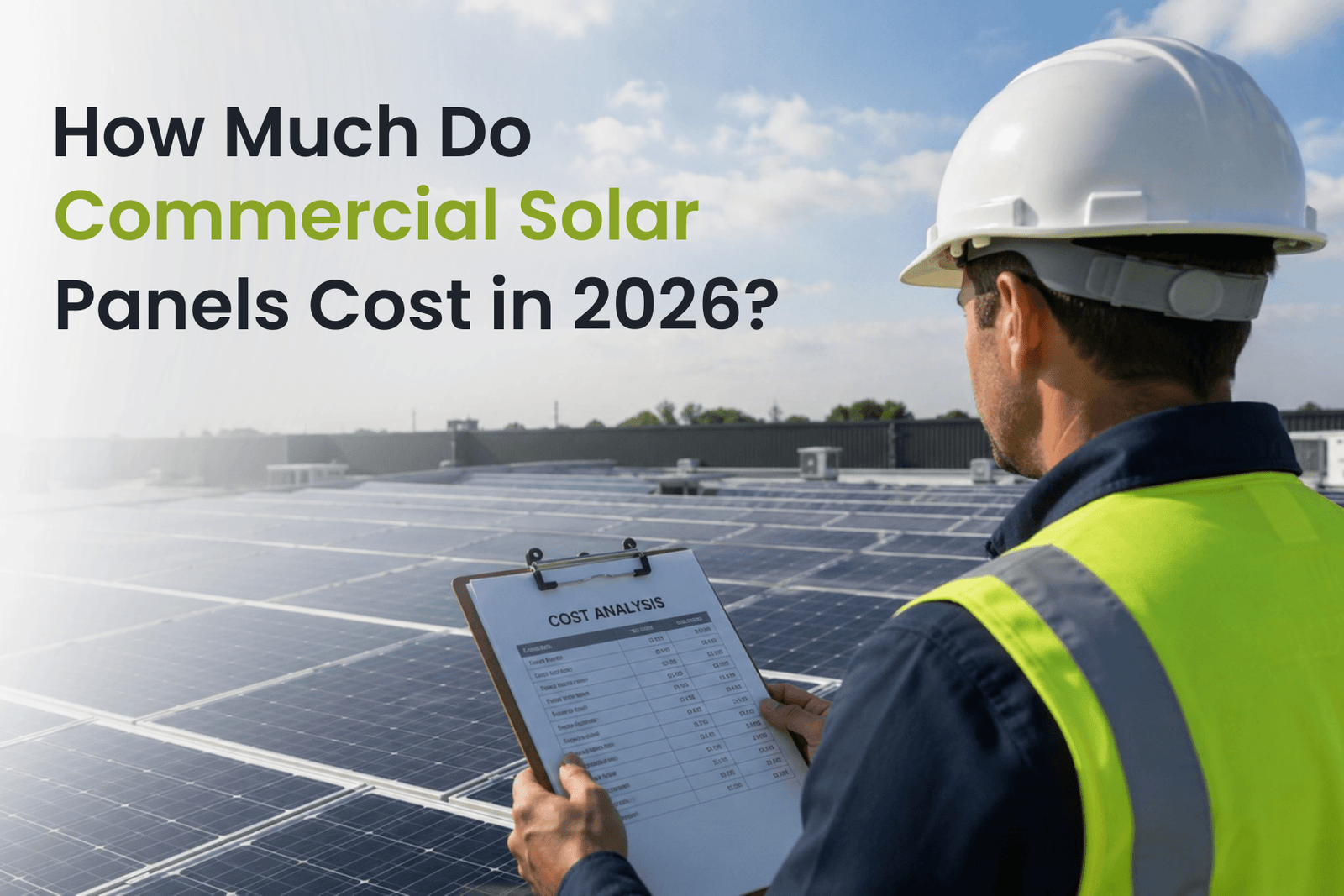
In 2026, the commercial solar system cost in India ranges from ₹45 to ₹70 per watt (all-inclusive), translating to roughly ₹27 lakh to ₹45 lakh for a 50 kW system and ₹40 lakh to ₹60 lakh for 100 kW. Thanks to accelerated depreciation benefits and rising grid tariffs, most businesses recover that investment in 3 to 5 years and then run on near-free electricity for the next two decades.

What Does a Commercial Solar System Actually Cost in India?

The number that trips up most business owners is confusing panel cost with installed system cost. They are very different things.

Solar panel prices in India currently range from ₹22 to ₹38 per watt depending on the technology; polycrystalline panels sit at the lower end around ₹22 to ₹25 per watt, while premium bifacial mono panels go up to ₹35 to ₹38 per watt. But the panel alone is only part of what you pay for.

A complete working system includes the inverter, mounting structure, wiring, earthing, protection equipment, and labour. For commercial installations, the all-inclusive commercial solar panel cost per watt benefits from economies of scale. A 50 kW commercial rooftop system typically costs between ₹27.5 lakh and ₹40 lakh, fully installed.

Here is a practical size-wise breakdown for 2026:

System Size Typical Use Case Estimated Cost (All-inclusive)
25 kW Small office / showroom ₹14 – ₹20 lakh
50 kW Mid-size commercial building ₹27.5 – ₹40 lakh
100 kW Large office / hospital ₹40 – ₹60 lakh
500 kW Mid-size factory ₹1.8 – ₹2.5 crore
1 MW Large manufacturing unit ₹4 – ₹5 crore

For a 100 kW system, costs typically range from ₹40 lakh to ₹50 lakh depending on location, panel brand, and structural requirements. A 1 MW plant runs approximately ₹4 crore to ₹5 crore for a complete ground-mounted or large rooftop installation, including all balance-of-system components, installation, and grid commissioning.

One thing worth noting in 2026: ALMM enforcement and China’s revised export policies have pushed commercial solar project costs up by approximately 25% compared to last year for commercial and industrial buyers. If you got a quote 12 months ago, get a fresh one.

What Goes Into the Cost of Installing Solar Panels for an Office Building?

The cost of installing solar panels for an office building has a few layers most vendors don’t break down clearly upfront. Here is what you are actually paying for:

Panels (40–50% of total cost): The module itself. For commercial projects, Mono PERC and TOPCon bifacial panels from ALMM-listed brands like Waaree, Adani, and Vikram Solar are the standard. TOPCon panels cost ₹28 to ₹36 per watt and deliver higher efficiency, making them suitable for buildings with limited rooftop space.

Inverter (15–20%): For commercial setups, string inverters or central inverters are common. Quality matters here more than with panels; a cheap inverter can undermine an otherwise solid system.

Mounting structure (10–15%): Rooftop structures are less expensive than ground-mounted ones, but the structural load assessment of the building is a non-negotiable step before installation.

Wiring, protection, earthing (8–12%): Often underestimated in quotes. Skimping here is where fire hazards originate.

Installation and commissioning (5–8%): Includes net metering application filing with your DISCOM, which is required for an on-grid commercial solar system.

Civil work and miscellaneous (5–10%): Waterproofing, cable trays, conduit, and switchgear panels.

What Is the Commercial Solar Panel Cost Per Watt in India Right Now?

For a typical commercial installation, the all-in commercial solar panel cost works out to around ₹45 to ₹70 per watt depending on system size, location, and component quality chosen. Larger systems push that cost per watt down.

The solar panel cost for a manufacturing unit follows a similar structure but sometimes runs higher because of the structural complexity of industrial roofs, heavier cable runs, and higher capacity inverters. A textile factory or food processing plant with a 500 kW requirement can realistically budget ₹1.8 crore to ₹2.5 crore for a complete rooftop installation.

The on-grid commercial solar system price is almost always lower than off-grid equivalents because you avoid battery costs entirely. In an on-grid setup, the grid acts as your virtual battery; you export surplus during peak sunlight hours and draw back when generation drops. Net metering regulations in most Indian states allow this exchange, though policy specifics vary by DISCOM.

Is There a Commercial Solar Subsidy in India in 2026?

This is where a lot of businesses get misled, so it is worth being direct.

Commercial and industrial consumers do not qualify for the PM Surya Ghar scheme, which is for residential consumers only. Any vendor promising you a “government subsidy” for a factory solar plant is likely misrepresenting the facts.

That does not mean there are no financial benefits; it just means they work differently for businesses.

Accelerated Depreciation (Section 32, Income Tax Act): This is the single most powerful financial lever for commercial solar in India. Solar power systems qualify for 40% accelerated depreciation in Year 1, with an additional 20% available if the plant is commissioned and operational for more than 180 days within the financial year. On a ₹1 crore system at a 25% tax rate, that translates to ₹10 lakh in tax benefit in Year 1 alone.

GST Input Tax Credit: Businesses registered for GST can claim 5% input tax credit on solar equipment, another cost recovery mechanism that residential buyers cannot access.

State-level incentives: Many states, including Gujarat, Rajasthan, and Maharashtra, have dedicated packages that complement central efforts, and the MNRE-GIFT (Green Investment and Financing for Transformation) scheme helps smaller units access credit at lower interest rates.

MNRE Capital Subsidy for Rooftop Solar (Commercial): The MNRE maintains its earlier policy of providing a capital subsidy to promote rooftop solar alongside depreciation benefits, and most states have streamlined procedures that allow for quicker installation and less bureaucracy. Check your state DISCOM for current slab availability, as eligibility criteria vary.

If your business is a registered MSME, the financial environment is particularly strong right now. The commercial solar subsidy India 2026 landscape for MSMEs blends depreciation benefits with interest rate concessions through institutional lenders.

What Are the Commercial Solar Financing Options in India?

Most businesses do not pay for a solar system entirely from working capital, and they should not have to. The commercial solar financing options in India in 2026 have matured considerably.

CAPEX Model (Ownership): You purchase the system outright, either with internal capital or a bank loan. You own the asset, claim accelerated depreciation, and keep 100% of the long-term savings. Rooftop CAPEX solar projects typically deliver an 18 to 22% internal rate of return in 2026. This is the model that makes the most financial sense for businesses with stable cash flows and tax liability.

Bank Loans: In 2026, Canara Bank and Union Bank of India offer competitive rates starting around 6.50% to 7.15% per annum for solar financing. SIDBI has historically been a strong lender for MSMEs. NBFCs like Tata Cleantech also actively finance commercial solar.

OPEX / RESCO / PPA Model: A third-party developer invests in and owns the rooftop solar system installed at your premises. Your business pays only for the electricity generated, usually under a long-term Power Purchase Agreement of 15 to 25 years at a rate lower than the grid tariff. Zero upfront investment, immediate savings from day one. The trade-off is you do not own the asset and cannot claim depreciation.

Solar Lease: A less common but emerging option where you pay a fixed monthly lease fee to use the system. Terms typically run 7 to 12 years.

For a business paying more than ₹50,000 per month in electricity bills, the CAPEX model almost always delivers better total returns over a 10-year window. For a business with tight capital or uncertain energy load, OPEX removes the financial risk entirely.

What Is the Commercial Solar Payback Period and ROI in India?

Here is where the numbers start to feel real.

A business that installs a 100 kW system, spending around ₹35 to ₹45 lakh, and saving roughly ₹10 lakh per year on electricity costs, is looking at a payback period of around 3.5 to 4.5 years. Over a system lifetime of 20 to 25 years, total savings can reach several crores. 

The commercial solar ROI calculator India inputs that matter most are your current per-unit electricity tariff, your daytime load profile, the system size, and whether you apply accelerated depreciation. For commercial installations accounting for accelerated depreciation and GST input tax credit, the effective payback reduces; a 500 kW commercial system with a gross cost of ₹2.0 crore can come down to a net cost of ₹1.7 crore, meaningfully shortening payback.

Typical commercial electricity rates in many Indian states hover between ₹8 and ₹12 per unit. By using commercial solar rooftop systems, a business can slash these costs by nearly 70%.

For commercial installations where electricity tariffs are higher, in the ₹10 to ₹14 per unit range, the payback can be as fast as 2.5 to 3 years.

The commercial solar payback period in India also varies by state DISCOM tariff. Maharashtra’s commercial tariffs for FY 2025–26 sit at ₹14.03 per kVAh for commercial consumers; that cost gap is precisely what compresses payback timelines for commercial buyers.

Which Are the Best Commercial Solar Panels in India for 2026?

The best commercial solar panels in India in 2026 are all ALMM-listed; this is not optional if you want DISCOM approval for net metering. From June 2026, all solar projects in India undergoing the net metering or open access process must use modules and cells produced in India and certified by ALMM, with no blanket relaxations beyond case-by-case reliefs.

The panels DS Group Solar consistently recommends and installs for commercial and industrial clients are bifacial TOPCon and Mono PERC modules from manufacturers like Waaree, Vikram Solar, Adani Solar, and Tata Power Solar, all of which carry BIS certification and ALMM listing. Vikram Solar panels are typically priced around ₹28 to ₹33 per watt, making them a reliable mid-to-premium choice for commercial buyers.

For manufacturing units with large, flat industrial roofs, bifacial panels on elevated racking structures can add 8 to 12% additional energy yield from reflected ground irradiance, worth the marginal premium at scale.

FAQ

Yes, meaningfully. Prices can vary by 5 to 15% across states due to logistics, local taxes, and DISCOM requirements. States like Rajasthan, MP, and Maharashtra have strong solar irradiance and established EPC ecosystems, which typically means better competitive pricing and faster approvals.

Absolutely, and you should. DS Group Solar offers a free solar calculator on its website. Input your current monthly bill, sanctioned load, and system size to get a clear payback and savings projection before any site visit.

After the payback period, the system continues generating free clean energy for 20 to 25 years, delivering a financial return that far exceeds most conventional business investments. The system also provides complete protection from rising grid tariffs, which have been escalating consistently across Indian states.

For a 50 to 100 kW rooftop installation, commissioning typically takes 30 to 60 days from site survey to final DISCOM approval, assuming structural clearances and net metering paperwork are in order. Larger systems above 500 kW may take 90 to 120 days. Working with a certified EPC company familiar with your state's DISCOM procedures, like DS Group Solar, which operates across Chhattisgarh and central India, shortens that timeline considerably.

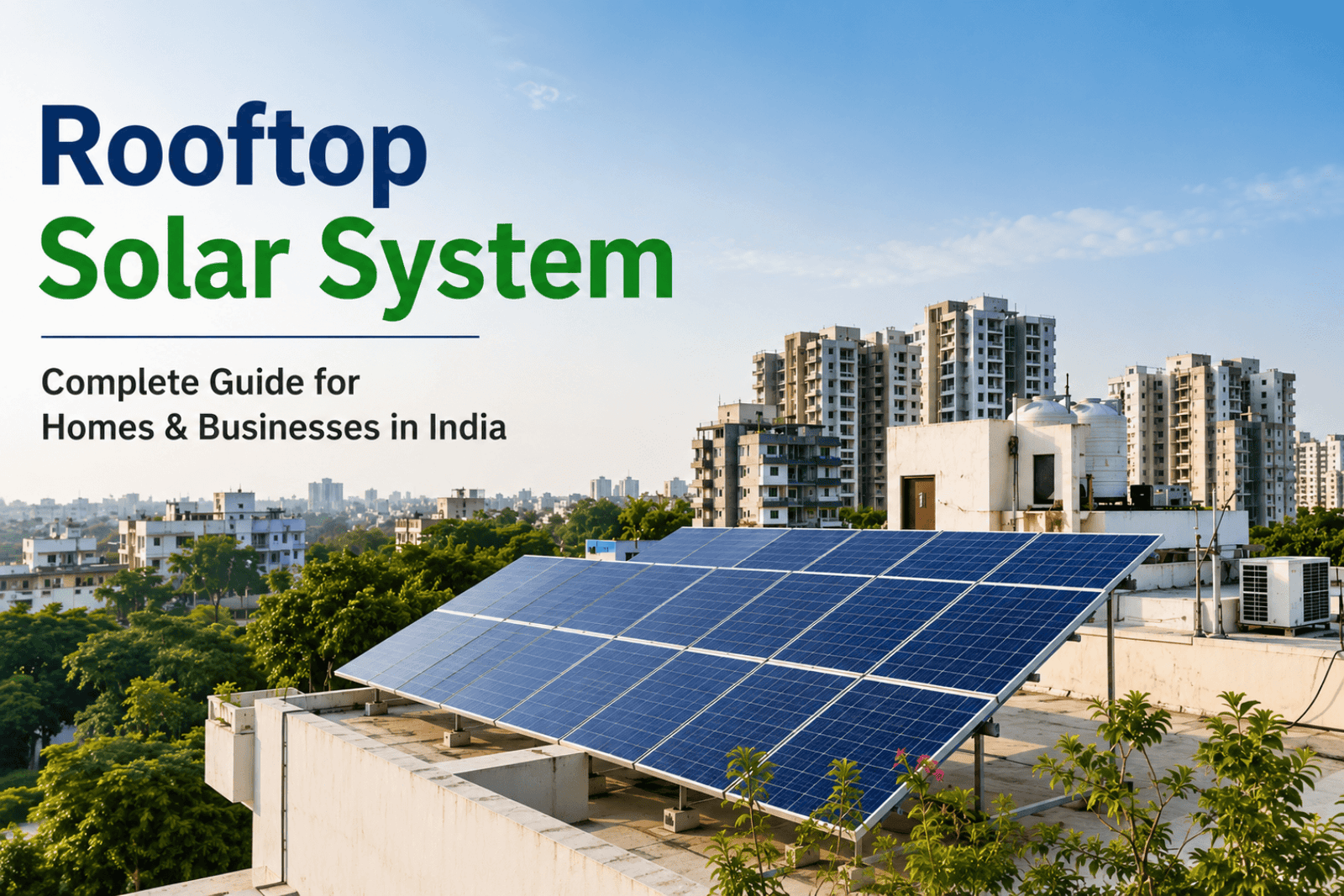
A rooftop solar system in India lets you generate electricity from sunlight, cut your power bills by 70 to 90 per cent, and sell extra units back to the grid. With the PM Surya Ghar Yojana subsidy, a 3 kW home system now costs around Rs 1 to 1.4 lakh after government support. Payback takes 4 to 6 years. Panels last 25.

What Is a Rooftop Solar System?

It is a set of solar panels installed on your roof that converts sunlight into electricity for your home or office.
The main parts are solar panels, an inverter, a mounting structure, wiring, and a net meter. Sunlight hits the panels and produces direct current (DC). The inverter converts this into alternating current (AC), which runs your appliances. Extra units you generate go to the grid, and your electricity board credits you for them through net metering.
Three types exist in India:

  • On-grid systems: Connected to the utility grid. No battery required. Best for homes and offices with a decent grid supply.
  • Off-grid systems: Run on battery storage. Suited for areas with frequent or long power cuts.
  • Hybrid systems: Grid-connected with battery backup. Good if outages are a problem but you also want net metering benefits.

For most Indian homes and offices in towns and cities, an on-grid system gives the best return.

What Size System Does Your Home Need?

Rooftop solar system size for homes in India depends on how many units you use each month.
Simple formula: divide your monthly consumption by 120. That gives you the approximate system size in kilowatts.

Monthly Consumption System Size Needed
Up to 150 units 1 to 2 kW
150 to 300 units 3 kW
300 to 500 units 4 to 5 kW
Above 500 units 6 kW or more

You also need about 10 square feet of clear, shadow-free roof space per 100 watts of capacity. A 3 kW system needs roughly 300 square feet of usable roof area facing south or west.

How Much Does a Rooftop Solar System Cost in India?

The rooftop solar cost in India for a home system runs between Rs 60,000 and Rs 75,000 per kilowatt before the subsidy. This price includes panels, an inverter, structure, wiring, and installation. A 3 kW system costs roughly Rs 1.8 to 2.2 lakh before any government support.
The solar subsidy for homes in India under PM Surya Ghar Yojana changes this picture:

System Size Central Subsidy
Up to 2 kW Rs 30,000 per kW
2 to 3 kW Rs 18,000 per kW for the extra capacity
Above 3 kW The total subsidy capped at Rs 78,000

After subsidy, a 3 kW system costs around Rs 1.1 to 1.4 lakh. That is a real saving on what was already a falling price.
For commercial rooftop solar India, the per-kW cost is a bit lower because of larger order sizes. No central subsidy applies to businesses, but they can claim 40 per cent accelerated depreciation in the first year under the Income Tax Act. Most commercial installations recover costs within 3 to 4 years.

What Is PM Surya Ghar Yojana and Who Qualifies?

The PM Surya Ghar Yojana solar scheme launched in February 2024. The government set aside Rs 75,000 crore to help 1 crore households install rooftop solar and get up to 300 free units per month.
To qualify, you need:

  • A valid residential electricity connection in your name
  • Owned residential property (rented homes are not eligible in most states)
  • Installation by a discom-empanelled solar vendor

Steps to apply:

  1. Register on pmsuryaghar.gov.in
  2. Apply for net metering through your local electricity board (DISCOM).
  3. Get the system installed by an approved vendor
  4. Upload installation details and your bank account number on the portal
  5. The subsidy reaches your account within 30 days of inspection

The paperwork looks like a lot. In practice, a good EPC company handles the discom coordination and subsidy filing for you. You mainly need to be available for the site inspection.

How Does the Rooftop Solar Installation Process Work?

The rooftop solar installation process takes 7 to 15 working days from site survey to switch-on. The main delay is usually net metering approval from the discom, not the physical installation.
Here is what happens step by step:

  1. Site survey: A solar engineer checks your roof area, shading, panel orientation options, structural load capacity, and your electricity bills.
  2. System design: Based on your usage and roof, the installer prepares a layout and gives you a quote.
  3. Discom application: Net metering application is filed with your electricity board.
  4. Material sourcing: ALMM-listed panels and BIS-certified components are procured. Only ALMM products qualify for government subsidy, so this step matters.
  5. Physical installation: The Mounting frame goes up first. Panels follow. The inverter and cables are connected. A 3 kW home system takes one to two days on-site.
  6. Discom inspection: An electricity board official visits, checks the system, and installs the bi-directional net meter.
  7. Commissioning: System goes live. Generation starts.

One thing worth knowing: always confirm your installer uses ALMM-approved and BIS-certified panels. Cheaper uncertified panels disqualify you from subsidies and often underperform within a few years.

Is Rooftop Solar Worth It in India?

For most homes and businesses in India, yes.
A straightforward example for a home in Chhattisgarh or Madhya Pradesh:

  • System cost after subsidy: around Rs 1.2 lakh
  • Monthly units generated: 360 to 400 units from a 3 kW system
  • Monthly savings at Rs 7 per unit: Rs 2,500 to 2,800
  • Annual savings: Rs 30,000 to 33,000
  • Payback period: 3.5 to 4 years
  • Panel life: 25 years

That means roughly 20 years of near-free electricity after the system pays itself back. As grid tariffs rise each year, the savings grow with them.
The benefits of rooftop solar systems in India go beyond bill savings. You get protection against power cuts if you add a battery. Your property value goes up. Your carbon footprint drops. And you stop depending on a grid that is still unreliable in many parts of the country.

What About Commercial and Industrial Solar?

Commercial rooftop solar in India covers offices, factories, schools, hospitals, and warehouses. System sizes start from 10 kW and scale to megawatts.
Key differences from residential:

  • No central subsidy, but 40 percent accelerated depreciation applies in year one
  • Higher returns because commercial tariffs are higher than domestic rates in most states
  • RESCO model available: zero upfront cost; you pay only per unit generated
  • Structural and load analysis is more detailed for large roofs

DS Group Solar, a full-service solar EPC company based in Chhattisgarh, operates across residential, commercial, and industrial segments. The company has commissioned over 3,170 MW of solar capacity across India and currently has 306 MW of projects under construction.

Key Takeaways

Solar rooftop system costs in India have fallen by nearly 80 per cent over the past decade. The PM Surya Ghar Yojana subsidy, combined with net metering, makes this a sound financial decision for most households.
Start by looking at your last three electricity bills. Note your average monthly units. Check if your roof has clear, south- or west-facing space. Then get a site survey done. A good installer will tell you exactly what system fits your home, what the subsidy process looks like in your state, and what your actual payback period will be.
DS Group Solar offers free site consultations and manages the full process from design to discom approval across India. Visit dsgroupsolar.in or call +91 011 6926 9583 to get started.

FAQ

Individual flat owners usually cannot install independently. But housing societies can install a shared system on the common roof and distribute benefits through net metering. Some states have specific policies for this.

Output drops by 30 to 50 per cent on heavily overcast days but does not stop. On an on-grid system, you draw the difference from the grid. Over the full year, sunny months compensate well for the monsoon period in most Indian cities.

Very little. Clean the panels once a month or after a dust storm. Get a yearly electrical check. Inverters carry 5-year warranties. Panels come with 25-year performance guarantees. An annual maintenance contract costs Rs 3,000 to 6,000 for a home system.

On-grid uses net metering but gives no backup during outages. Off-grid runs on batteries and works without a grid connection but costs more upfront. Hybrid does both. For most urban homes, on-grid is the practical choice. Hybrid suits homes with frequent power cuts.

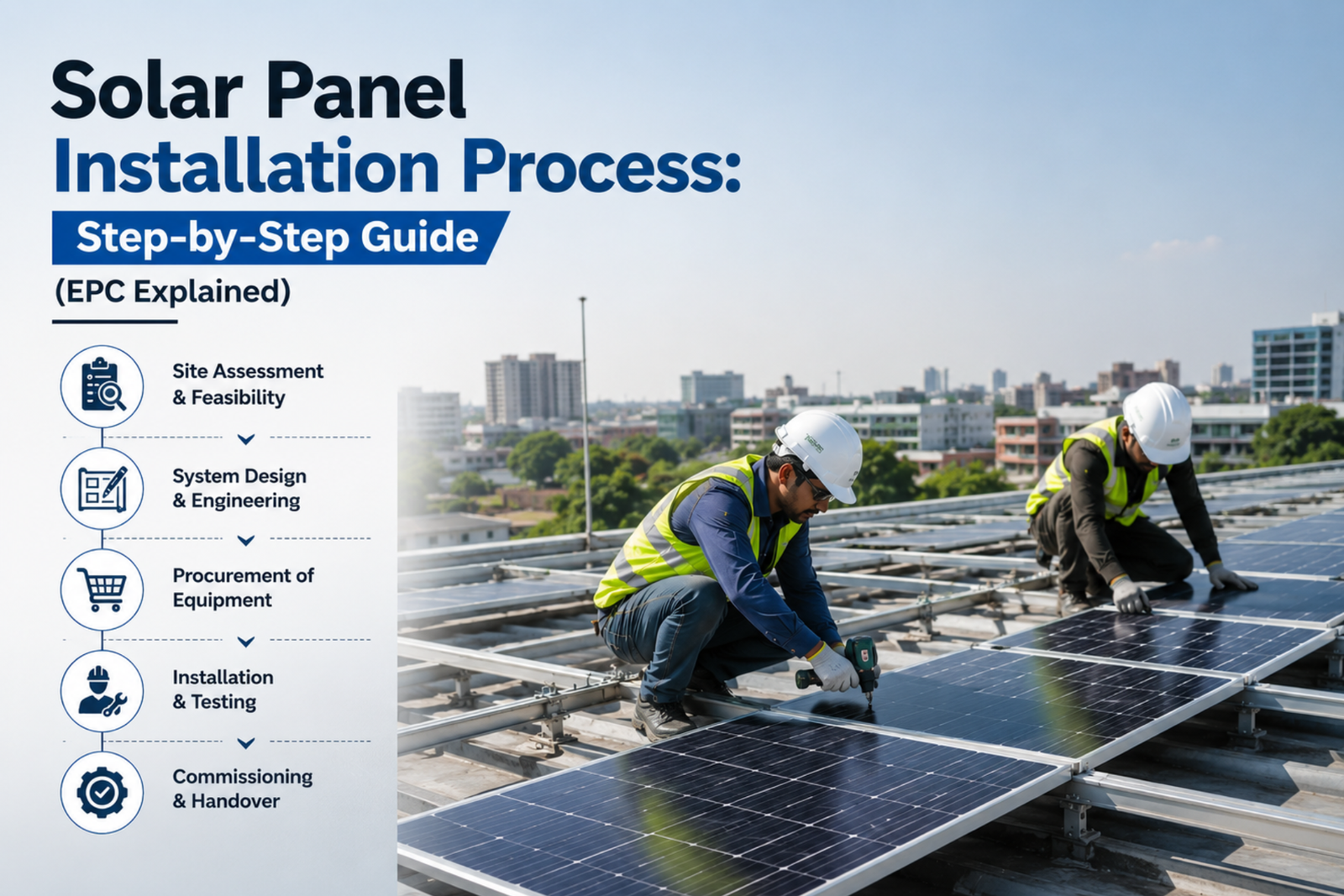
Installing solar panels on your home or business takes anywhere from 7 to 30 days depending on system size. The process runs through site survey, system design, equipment procurement, physical installation, grid connection, and final commissioning. In India, a certified solar panel installation company handles all of this under the EPC model, so you never have to coordinate between vendors yourself.

What Exactly Is EPC in Solar, and Why Does It Matter?

EPC stands for Engineering, Procurement, and Construction. It is the industry-standard model for delivering a complete solar project, and it is the reason a good installer can hand you a fully working system instead of a pile of parts.

Here is what each part actually means for you:

  • Engineering: Site assessment, shadow analysis, load calculation, and system design tailored to your roof area and consumption pattern.
  • Procurement: Sourcing BIS/ALMM-approved panels, inverters, mounting structures, cables, and protection devices from certified manufacturers.
  • Construction: Civil work, module mounting, electrical wiring, inverter installation, earthing, lightning protection, and grid synchronization.

When you hire a single EPC contractor rather than managing separate vendors, accountability sits in one place. If output falls short six months later, there is no blame game between a panel supplier and an electrical contractor.

How Does the Solar Panel Installation Process Work, Step by Step?

Step 1: Site Survey and Feasibility Study

Every legitimate home solar installation starts here. A trained engineer visits your site to measure roof dimensions, check the orientation (south-facing roofs in India receive maximum irradiation), assess shading from trees or adjacent buildings, and inspect the existing electrical panel.

At this stage the team also looks at your last 12 months of electricity bills. Your average monthly consumption in units (kWh) directly determines what system capacity you need. A household consuming 300 units per month typically needs a 3 kW system; a factory with peak demand of 100 kW needs a very different design.

Step 2: System Design and Load Calculation

Once site data is collected, engineers run it through simulation software (PVsyst is industry standard) to model annual energy generation. The output is a detailed single-line diagram showing panel layout, string configuration, inverter sizing, and expected performance ratio.

This is where a quality EPC firm earns its value. A properly designed home solar panels system minimizes mismatch losses, accounts for local weather patterns, and ensures the inverter never operates outside its optimal input range.

Step 3: Net Metering Application and DISCOM Approval

Before a single panel goes on your roof, you need prior approval from your electricity distribution company (DISCOM). This step trips up a lot of homeowners who skip it.

The application includes your load details, proposed system capacity, single-line diagram, and property documents. Processing time varies by state, anywhere from 7 days to 6 weeks. Reputable solar panel installers near me handle this paperwork as part of the EPC contract.

Under the PM Surya Ghar Muft Bijli Yojana scheme launched in 2024, residential consumers below 3 kW capacity are eligible for a central subsidy of up to Rs. 78,000. State-level subsidies stack on top of this in several states.

Step 4: Equipment Procurement Using ALMM-Listed Products

India’s Approved List of Models and Manufacturers (ALMM) is a Ministry of New and Renewable Energy (MNRE) directive that mandates the use of domestically approved solar modules for grid-connected systems. Choosing a non-ALMM panel disqualifies you from subsidies and, in some cases, from net metering approval itself.

A responsible EPC company sources only BIS and ALMM-certified panels. When comparing quotes from multiple solar companies near me, always ask for the make and model of the module and verify it on the MNRE ALMM portal.

Step 5: Mounting Structure Installation

This is the civil phase. The mounting structure (typically hot-dip galvanized steel or aluminum) gets anchored to the roof through a waterproofed fastening system. For RCC (concrete) roofs, anchor bolts are core-drilled and epoxy-grouted. For metal sheet roofs, purpose-built clamps are used that do not puncture the sheet.

Tilt angle matters here. In central India (Madhya Pradesh, Chhattisgarh), a fixed tilt of approximately 22 to 26 degrees south-facing captures the highest annual yield.

Step 6: PV Module and Inverter Installation

PV panel installation involves mounting modules onto the racking system, connecting them into strings, and running DC cables through conduit to the inverter location. String inverters are the most common choice for residential and small commercial systems up to 30 kW. For larger plants, central inverters or string inverters with DC combiners are used.

The inverter connects to your AC distribution board through an AC disconnect and bi-directional net meter. The entire DC and AC wiring follows IS/IEC standards, and all connections are checked for polarity, insulation resistance, and open-circuit voltage before energizing.

Step 7: Earthing, Lightning Protection, and Safety Checks

This step gets skipped or underdone by cheaper installers, and it shows up as equipment failure or safety hazards years later. A complete solar power installation requires dedicated earth pits for the array structure and inverter, surge protection devices (SPDs) on both DC and AC sides, and proper cable management to prevent rodent damage and fire risk.

An infrared (IR) scan after installation can detect hotspot-prone modules before they become a problem.

Step 8: Grid Synchronization and DISCOM Inspection

Once the system is physically complete, the DISCOM sends an inspector to verify compliance with the approved design. After clearance, they replace your existing meter with a bi-directional net meter that records both export and import.

The moment the inverter is switched on and synchronizes with the grid, your solar electricity installation is live. The bi-directional meter starts crediting excess units back to your account.

Step 9: Commissioning Report and Monitoring Setup

A thorough EPC company delivers a commissioning report that documents string voltages, inverter output, system efficiency ratio, and expected annual generation. Many systems today come with remote monitoring via IoT-enabled inverters that let you track live output, daily generation, and performance ratio from a mobile app.

This matters for the long run. A system generating 15% below expected output in year two needs investigation, not assumption.

What Does Solar Energy Installation Cost in India Right Now?

The cost of fitting solar panels in India in 2026 falls roughly in these ranges (before subsidy):

System Size Typical Use Case Approx. Cost (INR)
1 kW Small apartment Rs. 65,000 to Rs. 85,000
3 kW Mid-size home Rs. 1.6L to Rs. 2.1L
5 kW Large home / small shop Rs. 2.5L to Rs. 3.2L
10 kW Commercial establishment Rs. 4.5L to Rs. 5.8L
100 kW+ Industrial plant Negotiated per project

The solar energy installation cost varies based on panel brand, inverter quality, mounting structure type, civil work complexity, and your state’s infrastructure. Always get at least three quotes from verified solar providers near me and compare them on cost per Watt, not total price alone.

After applying the PM Surya Ghar subsidy, a 3 kW residential system can come down to under Rs. 90,000 net in many states.

How Do You Choose the Best Solar Panel Company for Your Project?

This question deserves an honest answer rather than a marketing one. Here is what actually separates a reliable installer from a price-first vendor:

  • MNRE empanelment: Check if the company appears on MNRE’s list of empanelled channel partners for subsidy-linked work.
  • ALMM compliance: Ask for the panel datasheet and verify the model on the official list.
  • Reference projects: A company with 3,000+ MW of commissioned projects handles unforeseen site challenges differently than one with 10 rooftop jobs.
  • Post-installation support: What is the O&M plan? Who do you call at 9 PM if the inverter trips?
  • Workmanship warranty: Separate from the panel manufacturer’s performance warranty, this covers installation quality for at least 5 years.

The best solar panel companies do not necessarily have the lowest per-Watt quote. They have the engineering depth to design correctly, the procurement relationships to source genuine equipment, and the accountability to stand behind the system for 25 years.


FAQs

How long does a complete solar panel installation take from start to finish?

For a residential system (3 to 10 kW), the physical installation takes 2 to 3 days. Add 1 to 4 weeks for DISCOM approval and net meter installation. The total timeline from contract signing to live system is typically 30 to 45 days.

Do I need a structural engineer’s assessment before installing solar panels for my home?

For RCC rooftops handling standard residential loads (up to 10 kW), most EPC companies conduct a visual assessment and check slab thickness. For older buildings, industrial facilities, or sheet-metal roofs, a structural audit is strongly recommended to confirm load-bearing capacity. A 10 kW system adds roughly 600 to 800 kg of distributed load.

What happens to my solar system during a power grid failure?

Grid-tied inverters shut down automatically during outages. This is a safety feature, not a fault. It prevents your system from back-feeding into utility lines where technicians may be working. If you want power during outages, you need a hybrid inverter with battery storage, which increases cost but adds energy independence.

Is net metering available in all Indian states?

Net metering is available across all states as a result of the Electricity (Rights of Consumers) Rules, 2020. However, implementation timelines and DISCOM responsiveness vary significantly. States like Gujarat, Maharashtra, and Karnataka have smoother net metering processes; some others still have approval delays.

How do I maintain my solar panels after installation?

Solar panels are largely low-maintenance. Periodic cleaning (once every 4 to 8 weeks in dusty regions like central India) restores generation efficiency. Annual electrical inspections covering cable integrity, connector checks, earthing continuity, and inverter diagnostics are recommended. Remote monitoring apps flag performance drops before they become significant losses.

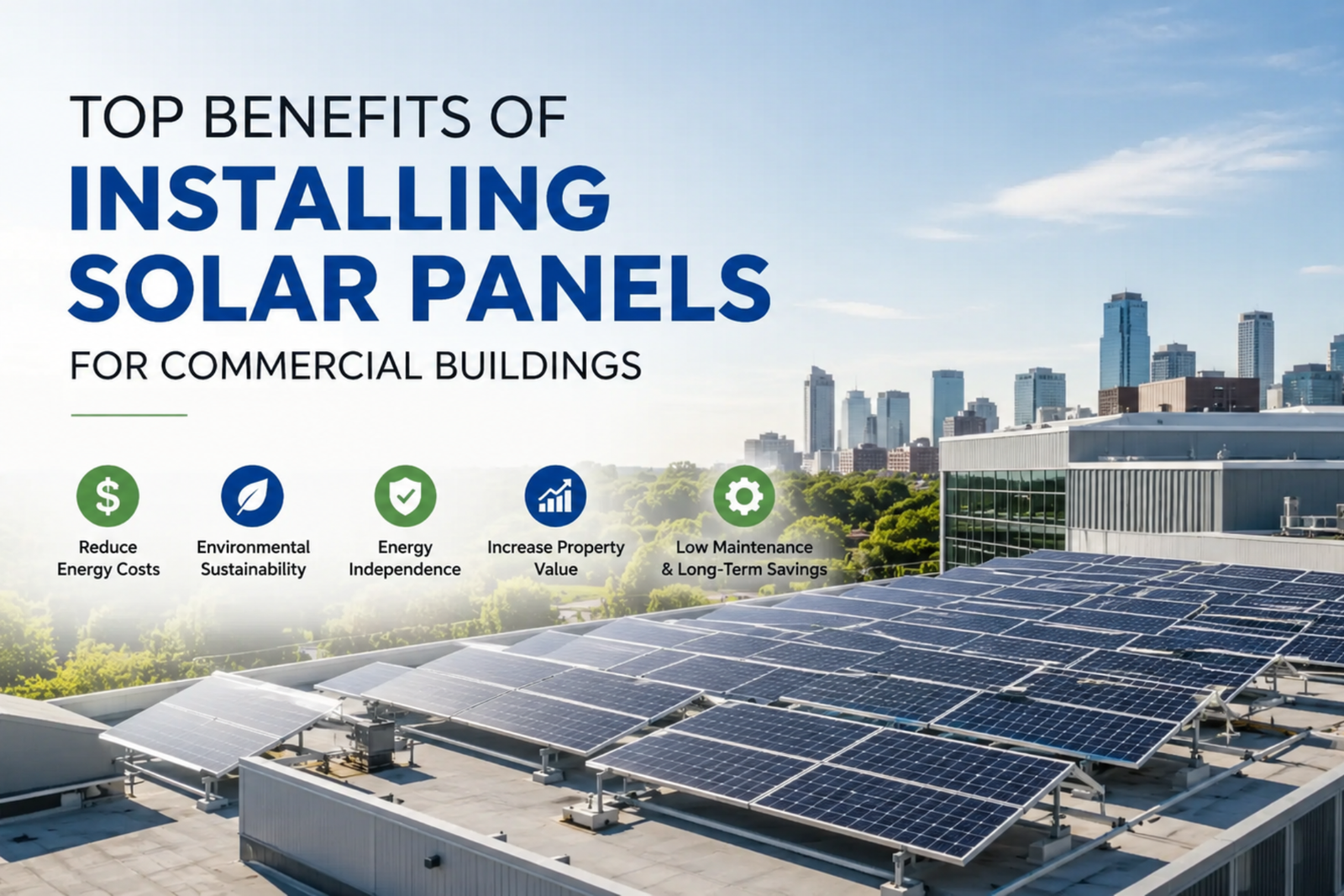
Installing solar panels on a commercial building can reduce electricity bills by 50–90%, offer a payback period of 4–7 years in India, and qualify your business for government incentives like accelerated depreciation and net metering. Whether you own a factory, office complex, or warehouse, commercial solar panels pay back far more than their upfront cost over a 25-year system life.

Why Are Businesses Switching to Solar Right Now?

The short answer: electricity costs in India have been climbing steadily, and businesses are feeling it more than anyone else. Commercial and industrial consumers pay among the highest per-unit tariffs because they don’t benefit from the subsidies that residential users receive. When a factory spends Rs. 8–12 per unit from the grid, even a modest 100 kW rooftop system can save Rs. 10–15 lakh annually.

That math is why solar energy for commercial buildings has moved from “nice to have” to a boardroom-level financial decision. And it’s not just about saving money. Clients, investors, and regulatory bodies are increasingly asking businesses to account for their carbon footprint. Solar gives you a concrete, measurable answer.

What Does Commercial Solar Installation Actually Involve?

A lot of people assume it’s just panels on a roof. The reality is more structured than that.

Commercial solar installation follows an EPC model: Engineering, Procurement, and Construction. A qualified team first assesses your rooftop area, structural load capacity, shadow analysis, sanctioned load, and grid connectivity. Then they design a system sized exactly to your consumption pattern, not a generic off-the-shelf solution.

The procurement stage involves sourcing panels, inverters, mounting structures, and cables that carry BIS and ALMM (Approved List of Models and Manufacturers) certification. This matters more than most buyers realise. ALMM-listed panels are the only ones eligible for government subsidies and many state-level net metering approvals. Using uncertified panels might save a few rupees per watt at purchase and cost you the entire incentive stack.

Construction covers structural mounting, DC and AC wiring, inverter installation, metering setup, and grid synchronisation. A professional commercial solar company handles all DISCOM approvals and net metering applications on your behalf, which can be the most time-consuming part of the process.

How Much Can a Business Actually Save?

Let’s put real numbers on it.

A 200 kW rooftop system on a commercial building in central India generates approximately 2.7–3.0 lakh units of electricity annually, based on an average of 5.5 peak sun hours per day. At Rs. 9 per unit (a conservative commercial tariff), that’s Rs. 24–27 lakh in annual savings.

System cost for a 200 kW commercial solar panel installation typically ranges between Rs. 70–90 lakh depending on panel type, structure complexity, and inverter brand. With a 40% accelerated depreciation benefit under Section 32 of the Income Tax Act, the effective first-year tax saving alone can be Rs. 8–12 lakh for a profitable business. That’s before you even count a single unit of generated power.

Payback periods in India typically land between 4 and 7 years for commercial installations. After that, you’re generating essentially free electricity for the remaining 18–20 years of the system’s life.

What Government Benefits Can Your Business Claim?

This is where many business owners leave money on the table because the incentive landscape is genuinely layered.

Accelerated Depreciation (AD): Businesses can claim 40% depreciation in the first year under the Income Tax Act. For a Rs. 80 lakh system, this translates to Rs. 32 lakh in depreciable value, potentially saving Rs. 10–11 lakh in taxes at a 34% effective tax rate.

Net Metering: Most states allow commercial consumers to export surplus solar power to the grid and receive credit on their electricity bills. If your business generates more power on weekends or during low-consumption periods, those units bank against future consumption.

PM-KUSUM Scheme: Primarily for agricultural and decentralised installations, but relevant for businesses with rural operations or ancillary agricultural land use.

GST Input Credit: Businesses registered under GST can claim input tax credit on GST paid during commercial solar systems procurement, further reducing the effective cost.

Why Is Rooftop Solar the Right Choice for Most Commercial Buildings?

Ground-mounted solar needs land. Most commercial buildings already have flat concrete rooftops sitting unused, effectively wasting real estate that generates no return. Commercial rooftop solar converts that dead space into an active revenue asset.

There’s also the operational angle. A rooftop system generates power at the point of consumption, which means you avoid transmission and distribution losses that typically add 20–30% to grid electricity costs. What the grid delivers to your meter has already lost a portion of its value in transmission. Solar power generated on your roof reaches your equipment directly.

For warehouse and manufacturing facilities, an insulated solar mounting structure can also reduce internal building temperatures by 3–5 degrees Celsius by shading the roof surface. In industries where air conditioning is a major cost, this secondary thermal benefit is genuinely significant.

How Does Industrial Solar Installation Differ from Standard Commercial Projects?

Industrial solar installation operates at a different scale and with a different set of engineering considerations.

Industrial customers typically consume between 500 kW and several MW of power, operate heavy equipment with high inductive loads and have strict power quality requirements. In a solar system for a textile mill, steel fabricator or pharmaceutical plant, the harmonic distortion, reactive power compensation and the interaction between solar inverters and large motor loads have to be considered.

That’s why experienced EPC companies perform detailed load flow analysis before finalising industrial solar designs. They also use hybrid inverter systems or battery storage where the industrial process cannot tolerate grid outages or frequency fluctuations.

Banking arrangements under state electricity regulatory commissions are also common in industrial solar installation projects, where the business can bank the units generated month on month and adjust them against the consumption during low-generation periods such as the monsoon months.

Are Solar Panels for Business a Good Fit for Every Type of Commercial Building?

Ideal candidates:

  • Buildings with at least 1,000 sq ft of unshaded rooftop space
  • Businesses operating during daylight hours (manufacturing, offices, retail)
  • Organizations with monthly electricity bills above Rs. 50,000
  • Properties with strong rooftop structure (RCC preferred over sheet metal)

Situations that need additional planning:

  • Heritage or heritage-adjacent buildings where structural modifications face restrictions
  • Buildings with heavy rooftop equipment (HVAC units and water tanks) that limit panel placement
  • Industrial units on rented premises where lease tenure may be shorter than payback period

For leased premises, a Power Purchase Agreement (PPA) model works well. A third-party developer installs and owns the system; you purchase solar power at a pre-agreed rate lower than the grid tariff. Zero upfront investment, immediate savings.

What Should You Look for in a Commercial Solar Company?

The solar industry in India has grown fast, which means quality varies widely between installers.

A credible commercial solar company will:

  • Use only ALMM-listed panels from Tier 1 manufacturers
  • Provide detailed shadow analysis and energy yield reports before quoting
  • Carry out structural load calculations and share them with the client
  • Handle all DISCOM and net metering documentation
  • Offer a minimum 5-year workmanship warranty separate from product warranties
  • Have a functioning Operations & Maintenance arm for post-installation support

Ask for references from completed commercial projects of similar size. Visit those sites if possible. The quality of cable management, earthing systems, and junction box placement reveals far more about workmanship than any brochure does.

What Are the Best Business Solar Solutions for Long-Term ROI?

The highest ROI solar configurations for commercial buildings generally combine on-grid rooftop systems with net metering and accelerated depreciation benefits. For businesses with critical power needs, adding a Battery Energy Storage System (BESS) creates a hybrid setup that provides backup power during outages while still exporting surplus to the grid.

Business solar solutions with IoT-based remote monitoring platforms add another layer of value. Real-time performance tracking lets facility managers catch underperformance early. A string that’s generating 15% below forecast might indicate bird droppings, a shading issue, or a faulty module. Catching this in week two instead of year three is the difference between minor cleaning and a significant yield loss.

Corporate solar panels with monitoring integration also generate ESG-reportable data: generation in kWh, CO₂ avoided, equivalent trees planted. These numbers feed directly into sustainability reports, CSR disclosures, and green building certifications like LEED or GRIHA.

FAQs

Q1. How long do commercial solar panels last? 

Quality panels from Tier 1 manufacturers carry a 25-year linear power output warranty, typically guaranteeing 80% or better output at year 25. Inverters generally have 5–10 year warranties and may need replacement once during the system’s life. The panels themselves routinely outlast their warranty period.

Q2. What happens to solar production during monsoon or cloudy days? 

Output drops but doesn’t stop. On heavily overcast days, a well-designed system typically produces 15–25% of its peak capacity. Net metering compensates for this by allowing you to bank surplus units generated during high-production months against deficit months. Over a full year, the averages work in your favour.

Q3. Does solar affect our building’s insurance or structural integrity? 

A properly engineered installation has no negative impact on structural integrity. In fact, panels protect the roof membrane from UV degradation and extend its life. You should inform your insurer about the installation. Most commercial property insurers include rooftop solar under standard coverage, though some require a rider.

Q4. Can we install solar if our building is on a lease? 

Yes, through a PPA or lease arrangement where a developer installs and owns the system. You buy power at below-grid rates. Alternatively, if the lease has enough tenure (typically 10+ years), many businesses proceed with ownership after securing an NOC from the landlord.

Q5. How do I size the right system for my business? 

Start with your last 12 months of electricity bills. A good EPC partner will analyse your load curve, peak demand hours, and available rooftop area to recommend a system that maximises self-consumption while staying within your sanctioned load. Oversizing beyond your consumption is rarely beneficial under most state net metering policies for commercial consumers.

A residential rooftop solar system in India costs between ₹55,000 and ₹85,000 per kW in 2026 for a complete on-grid installation. A typical home needs 3 kW to 5 kW, which works out to roughly ₹1.65 lakh to ₹3.75 lakh before subsidies. Apply for the PM Surya Ghar subsidy, and that number drops significantly, often cutting the payback period to under four years.

What Does a Solar Power System Actually Cost in India Right Now?

There is no single solar system price in India. The final number depends on system size, panel quality, inverter type, roof condition, and your state’s DISCOM policies. That said, 2026 has brought more price clarity than any year before.

The average installed cost for a complete on-grid residential system runs between ₹55,000 and ₹85,000 per kW, depending on equipment quality, roof type, and installer. This is the total cost of making solar actually work on your roof, including panels, an inverter, a mounting structure, wiring, and commissioning it. It is not just the panel price.

The panel-only price looks low, but the complete installed cost per watt, including inverter, mounting, wiring, and labour, sits at ₹55 to ₹85 per watt for residential on-grid systems in 2026.

The cheap solar era is over. A structural change due to global commodity inflation, China’s revised export policies and India’s enforcement of ALMM (Approved List of Models and Manufacturers) regulations has resulted in commercial and industrial buyers facing solar project costs approximately 25% higher than in 2025. For residential buyers, the picture is slightly different because PM Surya Ghar subsidies buffer the impact.

How Much Do a 3kW, 5kW, and 10kW System Cost?

Most homes fall into one of three size categories. Here is what you can realistically expect to pay in 2026:

System Size Before Subsidy After Subsidy (PM Surya Ghar) Ideal For
3 kW ₹1.65L – ₹2.25L ₹87,000 – ₹1.47L 2-3 BHK home, moderate usage
5 kW ₹2.75L – ₹3.75L ₹2.02L – ₹3.02L Larger home, 1-2 ACs
10 kW ₹5.5L – ₹8.5L No direct subsidy Villas, small businesses

A 3kW solar system price in India for an on-grid rooftop sits at approximately ₹1,65,000 to ₹2,25,000 before subsidy. After the central government subsidy of ₹78,000, the effective cost comes down to approximately ₹87,000 to ₹1,47,000 depending on your city and installer.

For bigger installations, a typical 2026 band for a 5kW solar system price in India ranges from ₹2.75 lakh to ₹3.75 lakh, with the main swing factors being the inverter grade and structure.

The price of a 10kW solar system in India is where quotes differ the most. At this scale, you are essentially installing a small rooftop plant. String planning, DC/AC protections, distribution board integration, and monitoring all add layers of complexity and cost that smaller systems do not need. Expect ₹5.5 lakh to ₹8.5 lakh for a quality 10 kW residential or light commercial setup.

What Does the Solar Subsidy in India Look Like in 2026?

The PM Surya Ghar Muft Bijli Yojana is the central government’s flagship scheme for solar subsidies in India 2026, and it remains active and well-funded.

As of March 2026, the PM Surya Ghar Muft Bijli Yojana has received 63,26,125 applications, completed 25,02,217 installations, and benefited 31,12,850 households, as confirmed in a Lok Sabha parliamentary reply dated March 6, 2026.

The subsidy structure works like this:

  • Up to 2 kW capacity: ₹30,000 per kW
  • 2 kW to 3 kW capacity: ₹18,000 per kW for the additional capacity
  • Maximum subsidy cap: ₹78,000 per household

Only on-grid (grid-tied) systems are eligible. Off-grid or standalone battery systems are not covered. The system must be installed by an MNRE-empanelled vendor. The subsidy is credited directly to your bank account within 30 days of DISCOM approval. One household can avail itself of the subsidy only once.

Government employees and income taxpayers are NOT eligible. This is a detail many families miss before applying.

For commercial and industrial buyers, the subsidy picture is different. Commercial and industrial rooftop systems generally do not receive direct capital subsidies but benefit from accelerated depreciation, net metering, and energy cost savings.

What Goes Into the Solar Installation Cost for a Home?

When you look at any solar panel installation cost for a home in India, it helps to break the quote apart. A transparent installer will itemise each component.

Core components and their approximate cost contribution:

  • Solar panels (modules): In 2026, solar panels cost between ₹16 to ₹40 per watt, with Mono PERC panels costing between ₹22 to ₹28 per watt. Tier-1 ALMM-listed manufacturer panels with higher efficiency and a 25-year linear output warranty.

  • Inverter: Generally 15 to 25% of total system cost. String inverters are standard; hybrid inverters cost more but allow battery integration later.

  • Mounting structure: Galvanised steel or aluminium rails. Never compromise here, as this is what keeps your panels standing through monsoon and heat cycles.

  • Wiring, DC/AC protections, earthing: Often bundled but must be explicitly listed in any quote.

  • Installation labour and commissioning: Varies by roof complexity and city.

If a quote looks unusually low, ask what is missing. DB work, earthing upgrades, and paperwork are common omissions in underbid quotes.

How Long Does It Take to Get Your Money Back?

The typical payback period is 3.5 to 6 years for residential systems in India, depending on system size, electricity tariff, and usage pattern. After payback, the system generates power for 20 or more years.

For homes that apply the PM Surya Ghar subsidy, payback compresses faster. A 3 kW system after subsidy costs around ₹1,00,000 to ₹1,32,000, with a payback period of 3 to 3.5 years and lifetime savings of ₹7 to ₹9 lakh over 25 years.

DS Group Solar, which operates as Solaxio DS Energy Pvt. Ltd. and has commissioned over 3,100 MW of solar projects across India, consistently sees residential clients in central India achieve payback within four years, particularly in states where grid tariffs have risen sharply over the past three years.

The risk of waiting? ALMM enforcement is expected to tighten further in the second half of 2026, which could push complete system costs up by another 10 to 15%. That is a real consideration if you are sitting on the fence.

How Do You Pick the Right Installer?

A cheap system installed badly will underperform for 25 years. Here is what to verify before signing any agreement: MNRE empanelment (only MNRE-empanelled vendors can process the PM Surya Ghar subsidy on your behalf), ALMM-listed panels, a transparent itemised quote, and a local after-sales support team.

Beyond credentials, ask the installer how they handle net metering paperwork with your DISCOM. This step delays many installations unnecessarily when the vendor is inexperienced or not locally connected.

DS Group Solar handles EPC (Engineering, Procurement and Construction) for residential rooftop, commercial, and large-scale MW projects. Their team uses ALMM-BIS-approved components and stays involved post-commissioning, including remote monitoring and O&M services. That matters when you are thinking about a 25-year investment.

FAQs

How much does a home solar system price in India cost in 2026 for a 2 BHK flat? 

A 2 BHK home with moderate consumption (300 to 400 units per month) typically needs a 3 kW system. That costs ₹1.65 lakh to ₹2.25 lakh before the subsidy and around ₹87,000 to ₹1.47 lakh after applying the PM Surya Ghar benefit.

Is the solar panel cost for homes in India different from what commercial properties pay? 

Yes, residential and commercial costs differ in two ways. Residential buyers get subsidies; commercial buyers do not. However, commercial buyers get accelerated depreciation benefits under income tax provisions, which reduces their effective cost over time.

What is the solar power system cost per kW in India for 2026? 

For a complete on-grid residential installation, the benchmark is ₹55,000 to ₹85,000 per kW. Premium systems with high-efficiency panels and hybrid inverters can exceed this range. If a quote comes in significantly below ₹55,000 per kW, ask what components are excluded.

Can I get a loan to cover solar panel installation costs for a home in India? 

Under PM Surya Ghar Muft Bijli Yojana, all nationalised banks and major financial institutions offer collateral-free solar loans starting from 7% interest per annum for systems up to 3 kW. The loan amount can go up to ₹2 lakh for systems of up to 3 kW capacity.

Does the rooftop solar system cost in India vary by state? 

Yes, meaningfully so. States with higher grid electricity tariffs, like Maharashtra, Rajasthan, and Tamil Nadu, offer better financial returns on the same system. Additionally, some states layer their own subsidies on top of the central PM Surya Ghar subsidy, further reducing upfront costs. Your DISCOM’s net metering policy also affects how much value you get back from surplus generation.

The Backbone of a Reliable Solar Power Plant

In a utility-scale or rooftop solar power plant, the success of power generation does not depend only on solar modules and inverters. Two of the most critical groundwork activitiesMMS (Module Mounting Structure) installation and cable trenching work—form the backbone of a safe, durable, and efficient solar plant. Proper execution of these activities ensures long-term structural stability, electrical safety, and optimized plant performance.


Importance of MMS Structure Installation

The Module Mounting Structure (MMS) is the foundation on which solar modules are installed. A well-designed and accurately installed MMS ensures maximum energy generation, resistance against environmental loads, and long operational life.

Key Objectives of MMS Installation

  • Strong mechanical support for solar modules

  • Accurate tilt and orientation for maximum solar irradiation

  • Resistance to wind load, corrosion, and seismic activity

  • Long-term durability with minimal maintenance


MMS Structure Installation Process

1. Site Survey & Layout Marking

Before installation, a detailed site survey is conducted. Layout marking is done as per approved GA drawings to maintain row spacing, module pitch, and alignment accuracy.

2. Foundation / Pile Installation

Depending on soil conditions and design, foundations may include:

  • Pile driving

  • Micro piling

  • RCC foundations

All foundations are checked for verticality, depth, and strength.

3. Structure Erection

After foundation readiness:

  • Columns, rafters, purlins, and bracings are installed

  • Proper torque tightening is ensured using calibrated torque wrenches

  • Degree alignment and leveling are verified

4. Quality & Safety Checks

  • Bolt torque verification

  • Structural alignment inspection

  • Corrosion protection checks (GI/HDG coating)

  • Compliance with design and safety standards


Cable Trenching Work in Solar Power Plants

Cable trenching is a crucial civil and electrical activity that ensures safe routing of DC, AC, and communication cables across the plant.

Purpose of Cable Trenching

  • Protect underground cables from mechanical damage

  • Ensure safe power transmission

  • Maintain organized and accessible cable routing

  • Enhance plant safety and aesthetics


Cable Trenching Execution Process

1. Trench Excavation

  • Trenches are excavated as per approved route drawings

  • Depth and width maintained according to cable size and voltage level

  • Trench bottoms are cleaned and leveled

2. Sand Bedding & Cable Laying

  • Fine sand bedding is laid to protect cable insulation

  • Cables are laid carefully without bending stress

  • Proper spacing is maintained between multiple cables

3. Cable Protection & Identification

  • Protective covers (bricks, concrete slabs, or cable tiles) are placed

  • Warning tapes are installed above cables

  • Cable markers and route identification provided

4. Backfilling & Compaction

  • Trenches are backfilled with soft soil

  • Mechanical or manual compaction is done

  • Surface restoration is completed


Best Practices for MMS & Trenching Work

  • Use approved drawings and specifications

  • Follow IS standards and project safety guidelines

  • Ensure trained manpower and proper tools

  • Maintain documentation for quality control

  • Conduct regular inspections during execution

India – As India accelerates its ambitious journey toward renewable energy targets, the DS Group has reinforced its strategic commitment to the Solar Engineering, Procurement, and Construction (EPC) sector. By prioritizing high-standard energy solutions and robust project management, the company aims to play a pivotal role in the nation’s clean energy transition.

Commitment to Quality and Innovation

In a sector often defined by the speed of deployment, DS Group is distinguishing itself through a steadfast focus on quality and technical excellence. According to the company’s recent statement, their operational philosophy is built on delivering high-standard energy solutions that do not compromise on safety or longevity.

The company has outlined a comprehensive approach to solar infrastructure, emphasizing “safe structures” and “sustainable development.” This focus ensures that solar assets are not only efficient upon commissioning but remain durable and reliable throughout their lifecycle.

Reliable Project Management and Timely Execution

One of the critical challenges in the Indian infrastructure sector is project delay. Addressing this, DS Group has positioned “reliable project management” and “timely execution” at the core of its value proposition. By streamlining workflows and utilizing advanced engineering practices, the group aims to deliver projects on schedule, ensuring clients receive immediate value from their energy investments.

Contributing to a Greener India

The company’s vision aligns seamlessly with India’s national goals for carbon reduction and green energy adoption.

“Our goal is to make a leading contribution to India’s clean energy transition,” the company stated. By integrating sustainable development practices into their EPC services, DS Group is looking to empower clients to reduce their carbon footprints effectively.

Industry Impact

As the demand for renewable energy grows among commercial and industrial sectors, the role of specialized EPC players becomes crucial. DS Group’s emphasis on combining technical precision with safety standards positions them as a key enabler for businesses looking to adopt solar energy.

The group’s strategy reflects a maturing solar market in India, where the focus is shifting from mere capacity addition to the creation of high-quality, long-lasting energy assets.