
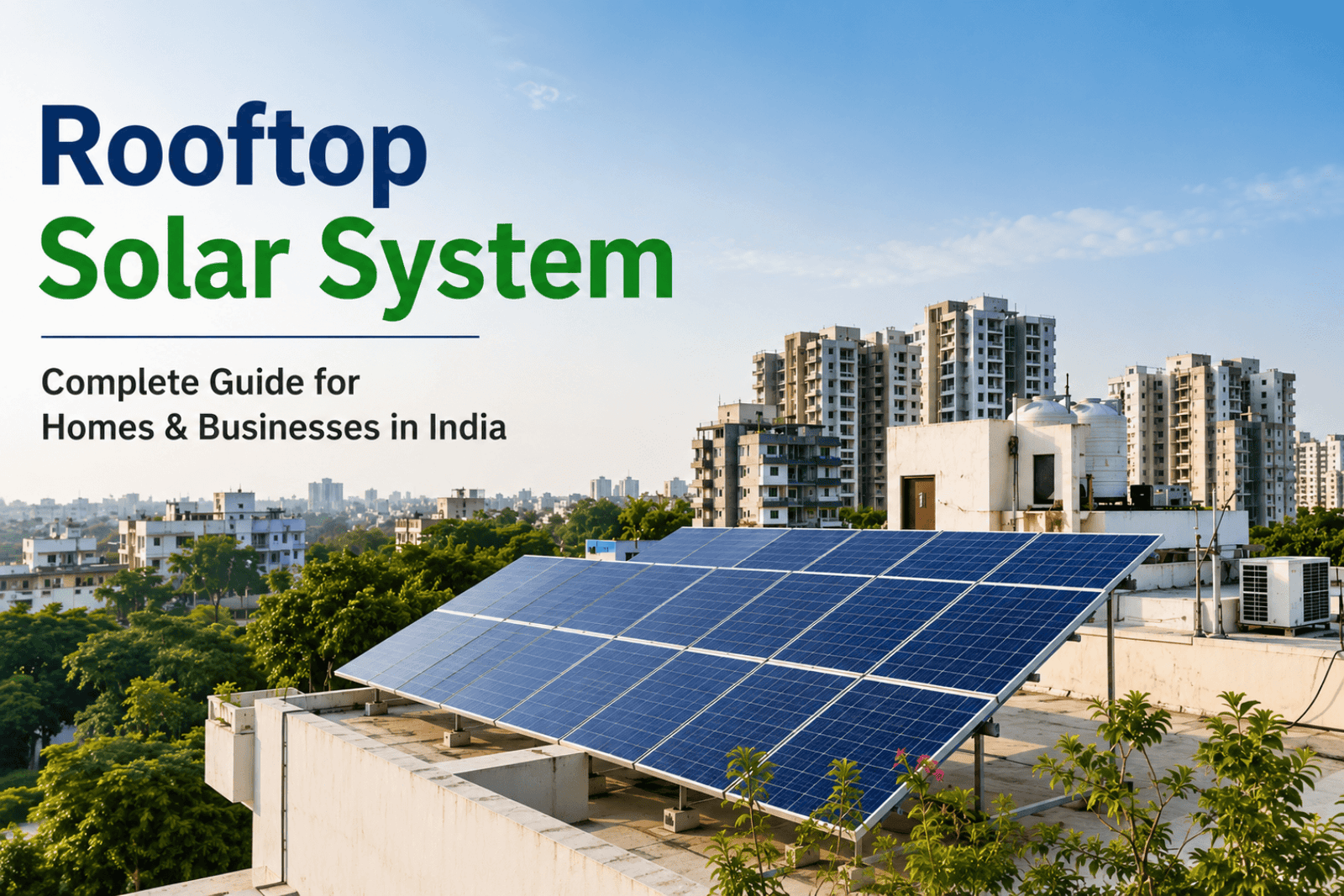
A rooftop solar system in India lets you generate electricity from sunlight, cut your power bills by 70 to 90 per cent, and sell extra units back to the grid. With the PM Surya Ghar Yojana subsidy, a 3 kW home system now costs around Rs 1 to 1.4 lakh after government support. Payback takes 4 to 6 years. Panels last 25.
What Is a Rooftop Solar System?
It is a set of solar panels installed on your roof that converts sunlight into electricity for your home or office.
The main parts are solar panels, an inverter, a mounting structure, wiring, and a net meter. Sunlight hits the panels and produces direct current (DC). The inverter converts this into alternating current (AC), which runs your appliances. Extra units you generate go to the grid, and your electricity board credits you for them through net metering.
Three types exist in India:
- On-grid systems: Connected to the utility grid. No battery required. Best for homes and offices with a decent grid supply.
- Off-grid systems: Run on battery storage. Suited for areas with frequent or long power cuts.
- Hybrid systems: Grid-connected with battery backup. Good if outages are a problem but you also want net metering benefits.
For most Indian homes and offices in towns and cities, an on-grid system gives the best return.
What Size System Does Your Home Need?
Rooftop solar system size for homes in India depends on how many units you use each month.
Simple formula: divide your monthly consumption by 120. That gives you the approximate system size in kilowatts.
| Monthly Consumption | System Size Needed |
| Up to 150 units | 1 to 2 kW |
| 150 to 300 units | 3 kW |
| 300 to 500 units | 4 to 5 kW |
| Above 500 units | 6 kW or more |
You also need about 10 square feet of clear, shadow-free roof space per 100 watts of capacity. A 3 kW system needs roughly 300 square feet of usable roof area facing south or west.
How Much Does a Rooftop Solar System Cost in India?
The rooftop solar cost in India for a home system runs between Rs 60,000 and Rs 75,000 per kilowatt before the subsidy. This price includes panels, an inverter, structure, wiring, and installation. A 3 kW system costs roughly Rs 1.8 to 2.2 lakh before any government support.
The solar subsidy for homes in India under PM Surya Ghar Yojana changes this picture:
| System Size | Central Subsidy |
| Up to 2 kW | Rs 30,000 per kW |
| 2 to 3 kW | Rs 18,000 per kW for the extra capacity |
| Above 3 kW | The total subsidy capped at Rs 78,000 |
After subsidy, a 3 kW system costs around Rs 1.1 to 1.4 lakh. That is a real saving on what was already a falling price.
For commercial rooftop solar India, the per-kW cost is a bit lower because of larger order sizes. No central subsidy applies to businesses, but they can claim 40 per cent accelerated depreciation in the first year under the Income Tax Act. Most commercial installations recover costs within 3 to 4 years.
What Is PM Surya Ghar Yojana and Who Qualifies?
The PM Surya Ghar Yojana solar scheme launched in February 2024. The government set aside Rs 75,000 crore to help 1 crore households install rooftop solar and get up to 300 free units per month.
To qualify, you need:
- A valid residential electricity connection in your name
- Owned residential property (rented homes are not eligible in most states)
- Installation by a discom-empanelled solar vendor
Steps to apply:
- Register on pmsuryaghar.gov.in
- Apply for net metering through your local electricity board (DISCOM).
- Get the system installed by an approved vendor
- Upload installation details and your bank account number on the portal
- The subsidy reaches your account within 30 days of inspection
The paperwork looks like a lot. In practice, a good EPC company handles the discom coordination and subsidy filing for you. You mainly need to be available for the site inspection.
How Does the Rooftop Solar Installation Process Work?
The rooftop solar installation process takes 7 to 15 working days from site survey to switch-on. The main delay is usually net metering approval from the discom, not the physical installation.
Here is what happens step by step:
- Site survey: A solar engineer checks your roof area, shading, panel orientation options, structural load capacity, and your electricity bills.
- System design: Based on your usage and roof, the installer prepares a layout and gives you a quote.
- Discom application: Net metering application is filed with your electricity board.
- Material sourcing: ALMM-listed panels and BIS-certified components are procured. Only ALMM products qualify for government subsidy, so this step matters.
- Physical installation: The Mounting frame goes up first. Panels follow. The inverter and cables are connected. A 3 kW home system takes one to two days on-site.
- Discom inspection: An electricity board official visits, checks the system, and installs the bi-directional net meter.
- Commissioning: System goes live. Generation starts.
One thing worth knowing: always confirm your installer uses ALMM-approved and BIS-certified panels. Cheaper uncertified panels disqualify you from subsidies and often underperform within a few years.
Is Rooftop Solar Worth It in India?
For most homes and businesses in India, yes.
A straightforward example for a home in Chhattisgarh or Madhya Pradesh:
- System cost after subsidy: around Rs 1.2 lakh
- Monthly units generated: 360 to 400 units from a 3 kW system
- Monthly savings at Rs 7 per unit: Rs 2,500 to 2,800
- Annual savings: Rs 30,000 to 33,000
- Payback period: 3.5 to 4 years
- Panel life: 25 years
That means roughly 20 years of near-free electricity after the system pays itself back. As grid tariffs rise each year, the savings grow with them.
The benefits of rooftop solar systems in India go beyond bill savings. You get protection against power cuts if you add a battery. Your property value goes up. Your carbon footprint drops. And you stop depending on a grid that is still unreliable in many parts of the country.
What About Commercial and Industrial Solar?
Commercial rooftop solar in India covers offices, factories, schools, hospitals, and warehouses. System sizes start from 10 kW and scale to megawatts.
Key differences from residential:
- No central subsidy, but 40 percent accelerated depreciation applies in year one
- Higher returns because commercial tariffs are higher than domestic rates in most states
- RESCO model available: zero upfront cost; you pay only per unit generated
- Structural and load analysis is more detailed for large roofs
DS Group Solar, a full-service solar EPC company based in Chhattisgarh, operates across residential, commercial, and industrial segments. The company has commissioned over 3,170 MW of solar capacity across India and currently has 306 MW of projects under construction.
Key Takeaways
Solar rooftop system costs in India have fallen by nearly 80 per cent over the past decade. The PM Surya Ghar Yojana subsidy, combined with net metering, makes this a sound financial decision for most households.
Start by looking at your last three electricity bills. Note your average monthly units. Check if your roof has clear, south- or west-facing space. Then get a site survey done. A good installer will tell you exactly what system fits your home, what the subsidy process looks like in your state, and what your actual payback period will be.
DS Group Solar offers free site consultations and manages the full process from design to discom approval across India. Visit dsgroupsolar.in or call +91 011 6926 9583 to get started.
FAQ
Can flat or apartment owners install rooftop solar?
Individual flat owners usually cannot install independently. But housing societies can install a shared system on the common roof and distribute benefits through net metering. Some states have specific policies for this.
What happens to generation during monsoon or cloudy days?
Output drops by 30 to 50 per cent on heavily overcast days but does not stop. On an on-grid system, you draw the difference from the grid. Over the full year, sunny months compensate well for the monsoon period in most Indian cities.
How much maintenance does a rooftop solar system need?
Very little. Clean the panels once a month or after a dust storm. Get a yearly electrical check. Inverters carry 5-year warranties. Panels come with 25-year performance guarantees. An annual maintenance contract costs Rs 3,000 to 6,000 for a home system.
What is the difference between on-grid, off-grid, and hybrid solar?
On-grid uses net metering but gives no backup during outages. Off-grid runs on batteries and works without a grid connection but costs more upfront. Hybrid does both. For most urban homes, on-grid is the practical choice. Hybrid suits homes with frequent power cuts.