
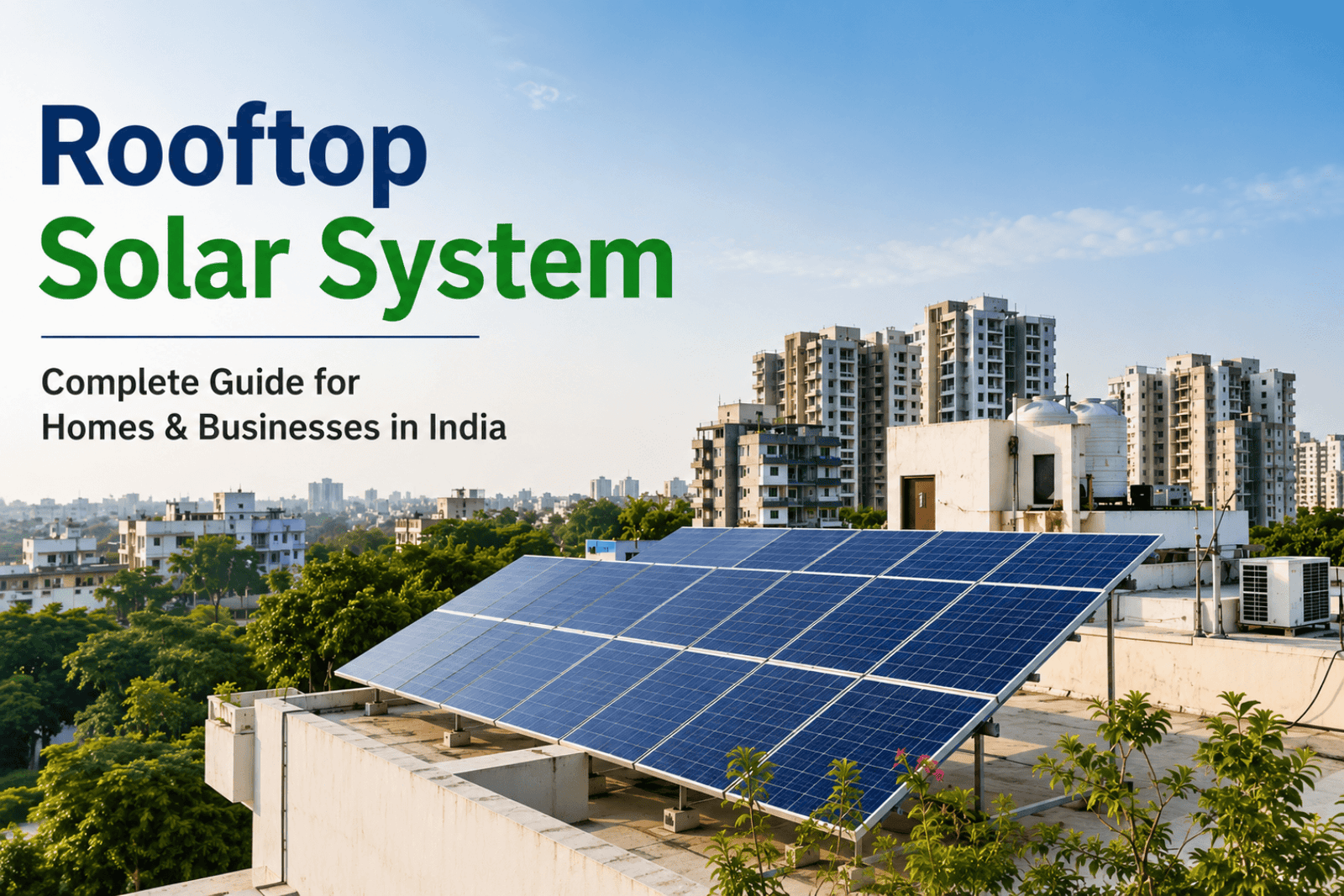
A rooftop solar system in India lets you generate electricity from sunlight, cut your power bills by 70 to 90 per cent, and sell extra units back to the grid. With the PM Surya Ghar Yojana subsidy, a 3 kW home system now costs around Rs 1 to 1.4 lakh after government support. Payback takes 4 to 6 years. Panels last 25.

What Is a Rooftop Solar System?

It is a set of solar panels installed on your roof that converts sunlight into electricity for your home or office.
The main parts are solar panels, an inverter, a mounting structure, wiring, and a net meter. Sunlight hits the panels and produces direct current (DC). The inverter converts this into alternating current (AC), which runs your appliances. Extra units you generate go to the grid, and your electricity board credits you for them through net metering.
Three types exist in India:

  • On-grid systems: Connected to the utility grid. No battery required. Best for homes and offices with a decent grid supply.
  • Off-grid systems: Run on battery storage. Suited for areas with frequent or long power cuts.
  • Hybrid systems: Grid-connected with battery backup. Good if outages are a problem but you also want net metering benefits.

For most Indian homes and offices in towns and cities, an on-grid system gives the best return.

What Size System Does Your Home Need?

Rooftop solar system size for homes in India depends on how many units you use each month.
Simple formula: divide your monthly consumption by 120. That gives you the approximate system size in kilowatts.

Monthly Consumption System Size Needed
Up to 150 units 1 to 2 kW
150 to 300 units 3 kW
300 to 500 units 4 to 5 kW
Above 500 units 6 kW or more

You also need about 10 square feet of clear, shadow-free roof space per 100 watts of capacity. A 3 kW system needs roughly 300 square feet of usable roof area facing south or west.

How Much Does a Rooftop Solar System Cost in India?

The rooftop solar cost in India for a home system runs between Rs 60,000 and Rs 75,000 per kilowatt before the subsidy. This price includes panels, an inverter, structure, wiring, and installation. A 3 kW system costs roughly Rs 1.8 to 2.2 lakh before any government support.
The solar subsidy for homes in India under PM Surya Ghar Yojana changes this picture:

System Size Central Subsidy
Up to 2 kW Rs 30,000 per kW
2 to 3 kW Rs 18,000 per kW for the extra capacity
Above 3 kW The total subsidy capped at Rs 78,000

After subsidy, a 3 kW system costs around Rs 1.1 to 1.4 lakh. That is a real saving on what was already a falling price.
For commercial rooftop solar India, the per-kW cost is a bit lower because of larger order sizes. No central subsidy applies to businesses, but they can claim 40 per cent accelerated depreciation in the first year under the Income Tax Act. Most commercial installations recover costs within 3 to 4 years.

What Is PM Surya Ghar Yojana and Who Qualifies?

The PM Surya Ghar Yojana solar scheme launched in February 2024. The government set aside Rs 75,000 crore to help 1 crore households install rooftop solar and get up to 300 free units per month.
To qualify, you need:

  • A valid residential electricity connection in your name
  • Owned residential property (rented homes are not eligible in most states)
  • Installation by a discom-empanelled solar vendor

Steps to apply:

  1. Register on pmsuryaghar.gov.in
  2. Apply for net metering through your local electricity board (DISCOM).
  3. Get the system installed by an approved vendor
  4. Upload installation details and your bank account number on the portal
  5. The subsidy reaches your account within 30 days of inspection

The paperwork looks like a lot. In practice, a good EPC company handles the discom coordination and subsidy filing for you. You mainly need to be available for the site inspection.

How Does the Rooftop Solar Installation Process Work?

The rooftop solar installation process takes 7 to 15 working days from site survey to switch-on. The main delay is usually net metering approval from the discom, not the physical installation.
Here is what happens step by step:

  1. Site survey: A solar engineer checks your roof area, shading, panel orientation options, structural load capacity, and your electricity bills.
  2. System design: Based on your usage and roof, the installer prepares a layout and gives you a quote.
  3. Discom application: Net metering application is filed with your electricity board.
  4. Material sourcing: ALMM-listed panels and BIS-certified components are procured. Only ALMM products qualify for government subsidy, so this step matters.
  5. Physical installation: The Mounting frame goes up first. Panels follow. The inverter and cables are connected. A 3 kW home system takes one to two days on-site.
  6. Discom inspection: An electricity board official visits, checks the system, and installs the bi-directional net meter.
  7. Commissioning: System goes live. Generation starts.

One thing worth knowing: always confirm your installer uses ALMM-approved and BIS-certified panels. Cheaper uncertified panels disqualify you from subsidies and often underperform within a few years.

Is Rooftop Solar Worth It in India?

For most homes and businesses in India, yes.
A straightforward example for a home in Chhattisgarh or Madhya Pradesh:

  • System cost after subsidy: around Rs 1.2 lakh
  • Monthly units generated: 360 to 400 units from a 3 kW system
  • Monthly savings at Rs 7 per unit: Rs 2,500 to 2,800
  • Annual savings: Rs 30,000 to 33,000
  • Payback period: 3.5 to 4 years
  • Panel life: 25 years

That means roughly 20 years of near-free electricity after the system pays itself back. As grid tariffs rise each year, the savings grow with them.
The benefits of rooftop solar systems in India go beyond bill savings. You get protection against power cuts if you add a battery. Your property value goes up. Your carbon footprint drops. And you stop depending on a grid that is still unreliable in many parts of the country.

What About Commercial and Industrial Solar?

Commercial rooftop solar in India covers offices, factories, schools, hospitals, and warehouses. System sizes start from 10 kW and scale to megawatts.
Key differences from residential:

  • No central subsidy, but 40 percent accelerated depreciation applies in year one
  • Higher returns because commercial tariffs are higher than domestic rates in most states
  • RESCO model available: zero upfront cost; you pay only per unit generated
  • Structural and load analysis is more detailed for large roofs

DS Group Solar, a full-service solar EPC company based in Chhattisgarh, operates across residential, commercial, and industrial segments. The company has commissioned over 3,170 MW of solar capacity across India and currently has 306 MW of projects under construction.

Key Takeaways

Solar rooftop system costs in India have fallen by nearly 80 per cent over the past decade. The PM Surya Ghar Yojana subsidy, combined with net metering, makes this a sound financial decision for most households.
Start by looking at your last three electricity bills. Note your average monthly units. Check if your roof has clear, south- or west-facing space. Then get a site survey done. A good installer will tell you exactly what system fits your home, what the subsidy process looks like in your state, and what your actual payback period will be.
DS Group Solar offers free site consultations and manages the full process from design to discom approval across India. Visit dsgroupsolar.in or call +91 011 6926 9583 to get started.

FAQ

Individual flat owners usually cannot install independently. But housing societies can install a shared system on the common roof and distribute benefits through net metering. Some states have specific policies for this.

Output drops by 30 to 50 per cent on heavily overcast days but does not stop. On an on-grid system, you draw the difference from the grid. Over the full year, sunny months compensate well for the monsoon period in most Indian cities.

Very little. Clean the panels once a month or after a dust storm. Get a yearly electrical check. Inverters carry 5-year warranties. Panels come with 25-year performance guarantees. An annual maintenance contract costs Rs 3,000 to 6,000 for a home system.

On-grid uses net metering but gives no backup during outages. Off-grid runs on batteries and works without a grid connection but costs more upfront. Hybrid does both. For most urban homes, on-grid is the practical choice. Hybrid suits homes with frequent power cuts.
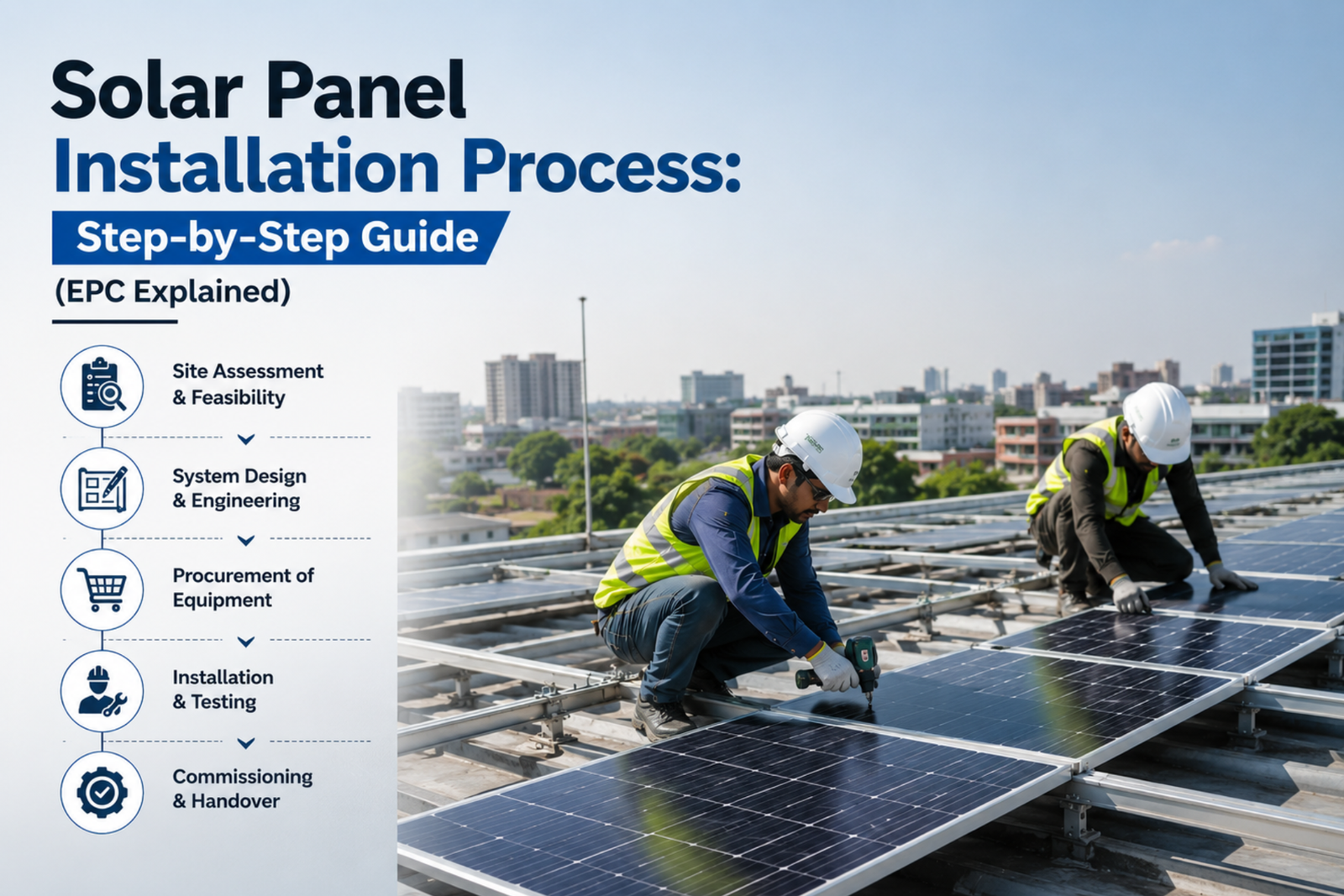
Installing solar panels on your home or business takes anywhere from 7 to 30 days depending on system size. The process runs through site survey, system design, equipment procurement, physical installation, grid connection, and final commissioning. In India, a certified solar panel installation company handles all of this under the EPC model, so you never have to coordinate between vendors yourself.

What Exactly Is EPC in Solar, and Why Does It Matter?

EPC stands for Engineering, Procurement, and Construction. It is the industry-standard model for delivering a complete solar project, and it is the reason a good installer can hand you a fully working system instead of a pile of parts.

Here is what each part actually means for you:

  • Engineering: Site assessment, shadow analysis, load calculation, and system design tailored to your roof area and consumption pattern.
  • Procurement: Sourcing BIS/ALMM-approved panels, inverters, mounting structures, cables, and protection devices from certified manufacturers.
  • Construction: Civil work, module mounting, electrical wiring, inverter installation, earthing, lightning protection, and grid synchronization.

When you hire a single EPC contractor rather than managing separate vendors, accountability sits in one place. If output falls short six months later, there is no blame game between a panel supplier and an electrical contractor.

How Does the Solar Panel Installation Process Work, Step by Step?

Step 1: Site Survey and Feasibility Study

Every legitimate home solar installation starts here. A trained engineer visits your site to measure roof dimensions, check the orientation (south-facing roofs in India receive maximum irradiation), assess shading from trees or adjacent buildings, and inspect the existing electrical panel.

At this stage the team also looks at your last 12 months of electricity bills. Your average monthly consumption in units (kWh) directly determines what system capacity you need. A household consuming 300 units per month typically needs a 3 kW system; a factory with peak demand of 100 kW needs a very different design.

Step 2: System Design and Load Calculation

Once site data is collected, engineers run it through simulation software (PVsyst is industry standard) to model annual energy generation. The output is a detailed single-line diagram showing panel layout, string configuration, inverter sizing, and expected performance ratio.

This is where a quality EPC firm earns its value. A properly designed home solar panels system minimizes mismatch losses, accounts for local weather patterns, and ensures the inverter never operates outside its optimal input range.

Step 3: Net Metering Application and DISCOM Approval

Before a single panel goes on your roof, you need prior approval from your electricity distribution company (DISCOM). This step trips up a lot of homeowners who skip it.

The application includes your load details, proposed system capacity, single-line diagram, and property documents. Processing time varies by state, anywhere from 7 days to 6 weeks. Reputable solar panel installers near me handle this paperwork as part of the EPC contract.

Under the PM Surya Ghar Muft Bijli Yojana scheme launched in 2024, residential consumers below 3 kW capacity are eligible for a central subsidy of up to Rs. 78,000. State-level subsidies stack on top of this in several states.

Step 4: Equipment Procurement Using ALMM-Listed Products

India’s Approved List of Models and Manufacturers (ALMM) is a Ministry of New and Renewable Energy (MNRE) directive that mandates the use of domestically approved solar modules for grid-connected systems. Choosing a non-ALMM panel disqualifies you from subsidies and, in some cases, from net metering approval itself.

A responsible EPC company sources only BIS and ALMM-certified panels. When comparing quotes from multiple solar companies near me, always ask for the make and model of the module and verify it on the MNRE ALMM portal.

Step 5: Mounting Structure Installation

This is the civil phase. The mounting structure (typically hot-dip galvanized steel or aluminum) gets anchored to the roof through a waterproofed fastening system. For RCC (concrete) roofs, anchor bolts are core-drilled and epoxy-grouted. For metal sheet roofs, purpose-built clamps are used that do not puncture the sheet.

Tilt angle matters here. In central India (Madhya Pradesh, Chhattisgarh), a fixed tilt of approximately 22 to 26 degrees south-facing captures the highest annual yield.

Step 6: PV Module and Inverter Installation

PV panel installation involves mounting modules onto the racking system, connecting them into strings, and running DC cables through conduit to the inverter location. String inverters are the most common choice for residential and small commercial systems up to 30 kW. For larger plants, central inverters or string inverters with DC combiners are used.

The inverter connects to your AC distribution board through an AC disconnect and bi-directional net meter. The entire DC and AC wiring follows IS/IEC standards, and all connections are checked for polarity, insulation resistance, and open-circuit voltage before energizing.

Step 7: Earthing, Lightning Protection, and Safety Checks

This step gets skipped or underdone by cheaper installers, and it shows up as equipment failure or safety hazards years later. A complete solar power installation requires dedicated earth pits for the array structure and inverter, surge protection devices (SPDs) on both DC and AC sides, and proper cable management to prevent rodent damage and fire risk.

An infrared (IR) scan after installation can detect hotspot-prone modules before they become a problem.

Step 8: Grid Synchronization and DISCOM Inspection

Once the system is physically complete, the DISCOM sends an inspector to verify compliance with the approved design. After clearance, they replace your existing meter with a bi-directional net meter that records both export and import.

The moment the inverter is switched on and synchronizes with the grid, your solar electricity installation is live. The bi-directional meter starts crediting excess units back to your account.

Step 9: Commissioning Report and Monitoring Setup

A thorough EPC company delivers a commissioning report that documents string voltages, inverter output, system efficiency ratio, and expected annual generation. Many systems today come with remote monitoring via IoT-enabled inverters that let you track live output, daily generation, and performance ratio from a mobile app.

This matters for the long run. A system generating 15% below expected output in year two needs investigation, not assumption.

What Does Solar Energy Installation Cost in India Right Now?

The cost of fitting solar panels in India in 2026 falls roughly in these ranges (before subsidy):

System Size Typical Use Case Approx. Cost (INR)
1 kW Small apartment Rs. 65,000 to Rs. 85,000
3 kW Mid-size home Rs. 1.6L to Rs. 2.1L
5 kW Large home / small shop Rs. 2.5L to Rs. 3.2L
10 kW Commercial establishment Rs. 4.5L to Rs. 5.8L
100 kW+ Industrial plant Negotiated per project

The solar energy installation cost varies based on panel brand, inverter quality, mounting structure type, civil work complexity, and your state’s infrastructure. Always get at least three quotes from verified solar providers near me and compare them on cost per Watt, not total price alone.

After applying the PM Surya Ghar subsidy, a 3 kW residential system can come down to under Rs. 90,000 net in many states.

How Do You Choose the Best Solar Panel Company for Your Project?

This question deserves an honest answer rather than a marketing one. Here is what actually separates a reliable installer from a price-first vendor:

  • MNRE empanelment: Check if the company appears on MNRE’s list of empanelled channel partners for subsidy-linked work.
  • ALMM compliance: Ask for the panel datasheet and verify the model on the official list.
  • Reference projects: A company with 3,000+ MW of commissioned projects handles unforeseen site challenges differently than one with 10 rooftop jobs.
  • Post-installation support: What is the O&M plan? Who do you call at 9 PM if the inverter trips?
  • Workmanship warranty: Separate from the panel manufacturer’s performance warranty, this covers installation quality for at least 5 years.

The best solar panel companies do not necessarily have the lowest per-Watt quote. They have the engineering depth to design correctly, the procurement relationships to source genuine equipment, and the accountability to stand behind the system for 25 years.


FAQs

How long does a complete solar panel installation take from start to finish?

For a residential system (3 to 10 kW), the physical installation takes 2 to 3 days. Add 1 to 4 weeks for DISCOM approval and net meter installation. The total timeline from contract signing to live system is typically 30 to 45 days.

Do I need a structural engineer’s assessment before installing solar panels for my home?

For RCC rooftops handling standard residential loads (up to 10 kW), most EPC companies conduct a visual assessment and check slab thickness. For older buildings, industrial facilities, or sheet-metal roofs, a structural audit is strongly recommended to confirm load-bearing capacity. A 10 kW system adds roughly 600 to 800 kg of distributed load.

What happens to my solar system during a power grid failure?

Grid-tied inverters shut down automatically during outages. This is a safety feature, not a fault. It prevents your system from back-feeding into utility lines where technicians may be working. If you want power during outages, you need a hybrid inverter with battery storage, which increases cost but adds energy independence.

Is net metering available in all Indian states?

Net metering is available across all states as a result of the Electricity (Rights of Consumers) Rules, 2020. However, implementation timelines and DISCOM responsiveness vary significantly. States like Gujarat, Maharashtra, and Karnataka have smoother net metering processes; some others still have approval delays.

How do I maintain my solar panels after installation?

Solar panels are largely low-maintenance. Periodic cleaning (once every 4 to 8 weeks in dusty regions like central India) restores generation efficiency. Annual electrical inspections covering cable integrity, connector checks, earthing continuity, and inverter diagnostics are recommended. Remote monitoring apps flag performance drops before they become significant losses.

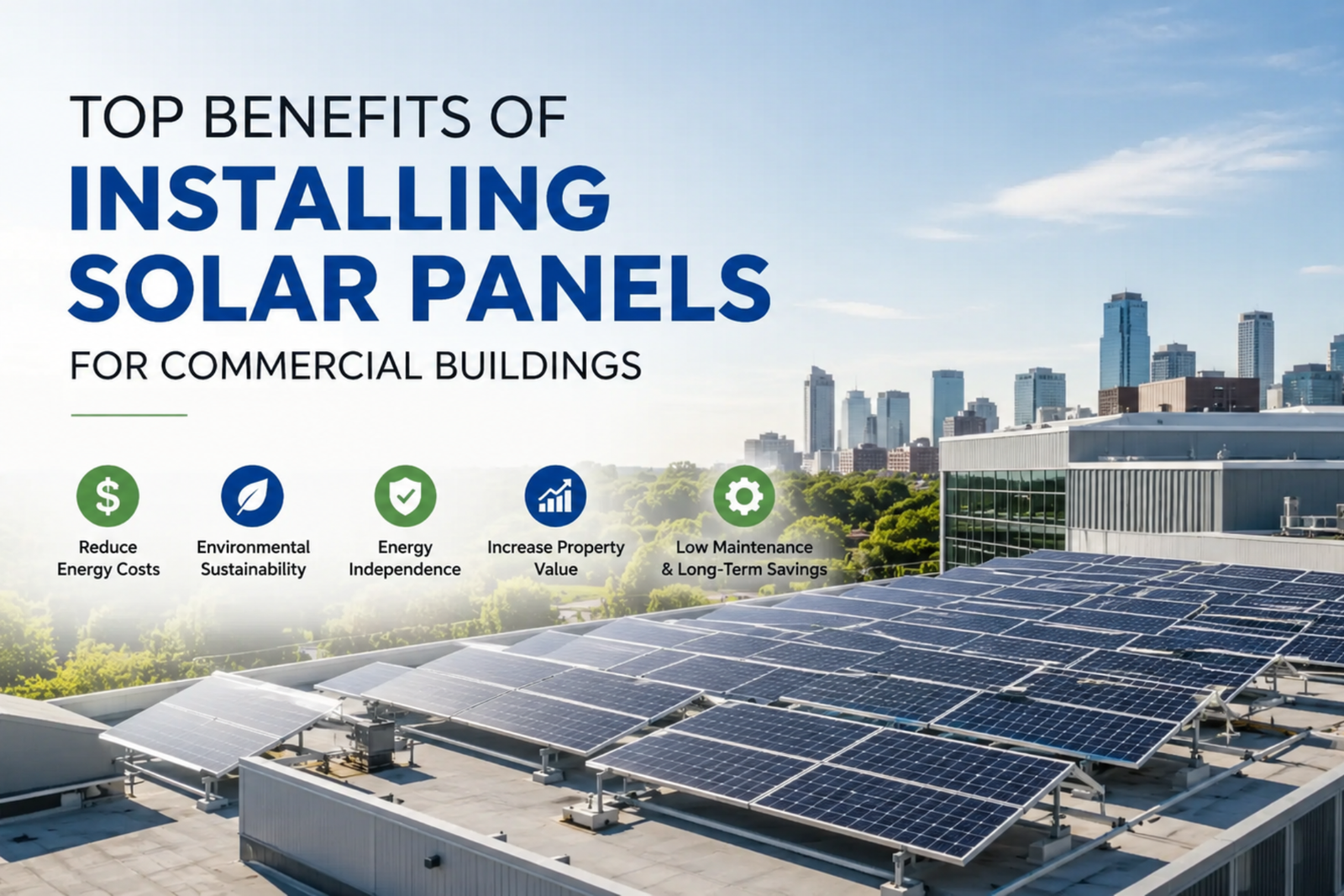
Installing solar panels on a commercial building can reduce electricity bills by 50–90%, offer a payback period of 4–7 years in India, and qualify your business for government incentives like accelerated depreciation and net metering. Whether you own a factory, office complex, or warehouse, commercial solar panels pay back far more than their upfront cost over a 25-year system life.

Why Are Businesses Switching to Solar Right Now?

The short answer: electricity costs in India have been climbing steadily, and businesses are feeling it more than anyone else. Commercial and industrial consumers pay among the highest per-unit tariffs because they don’t benefit from the subsidies that residential users receive. When a factory spends Rs. 8–12 per unit from the grid, even a modest 100 kW rooftop system can save Rs. 10–15 lakh annually.

That math is why solar energy for commercial buildings has moved from “nice to have” to a boardroom-level financial decision. And it’s not just about saving money. Clients, investors, and regulatory bodies are increasingly asking businesses to account for their carbon footprint. Solar gives you a concrete, measurable answer.

What Does Commercial Solar Installation Actually Involve?

A lot of people assume it’s just panels on a roof. The reality is more structured than that.

Commercial solar installation follows an EPC model: Engineering, Procurement, and Construction. A qualified team first assesses your rooftop area, structural load capacity, shadow analysis, sanctioned load, and grid connectivity. Then they design a system sized exactly to your consumption pattern, not a generic off-the-shelf solution.

The procurement stage involves sourcing panels, inverters, mounting structures, and cables that carry BIS and ALMM (Approved List of Models and Manufacturers) certification. This matters more than most buyers realise. ALMM-listed panels are the only ones eligible for government subsidies and many state-level net metering approvals. Using uncertified panels might save a few rupees per watt at purchase and cost you the entire incentive stack.

Construction covers structural mounting, DC and AC wiring, inverter installation, metering setup, and grid synchronisation. A professional commercial solar company handles all DISCOM approvals and net metering applications on your behalf, which can be the most time-consuming part of the process.

How Much Can a Business Actually Save?

Let’s put real numbers on it.

A 200 kW rooftop system on a commercial building in central India generates approximately 2.7–3.0 lakh units of electricity annually, based on an average of 5.5 peak sun hours per day. At Rs. 9 per unit (a conservative commercial tariff), that’s Rs. 24–27 lakh in annual savings.

System cost for a 200 kW commercial solar panel installation typically ranges between Rs. 70–90 lakh depending on panel type, structure complexity, and inverter brand. With a 40% accelerated depreciation benefit under Section 32 of the Income Tax Act, the effective first-year tax saving alone can be Rs. 8–12 lakh for a profitable business. That’s before you even count a single unit of generated power.

Payback periods in India typically land between 4 and 7 years for commercial installations. After that, you’re generating essentially free electricity for the remaining 18–20 years of the system’s life.

What Government Benefits Can Your Business Claim?

This is where many business owners leave money on the table because the incentive landscape is genuinely layered.

Accelerated Depreciation (AD): Businesses can claim 40% depreciation in the first year under the Income Tax Act. For a Rs. 80 lakh system, this translates to Rs. 32 lakh in depreciable value, potentially saving Rs. 10–11 lakh in taxes at a 34% effective tax rate.

Net Metering: Most states allow commercial consumers to export surplus solar power to the grid and receive credit on their electricity bills. If your business generates more power on weekends or during low-consumption periods, those units bank against future consumption.

PM-KUSUM Scheme: Primarily for agricultural and decentralised installations, but relevant for businesses with rural operations or ancillary agricultural land use.

GST Input Credit: Businesses registered under GST can claim input tax credit on GST paid during commercial solar systems procurement, further reducing the effective cost.

Why Is Rooftop Solar the Right Choice for Most Commercial Buildings?

Ground-mounted solar needs land. Most commercial buildings already have flat concrete rooftops sitting unused, effectively wasting real estate that generates no return. Commercial rooftop solar converts that dead space into an active revenue asset.

There’s also the operational angle. A rooftop system generates power at the point of consumption, which means you avoid transmission and distribution losses that typically add 20–30% to grid electricity costs. What the grid delivers to your meter has already lost a portion of its value in transmission. Solar power generated on your roof reaches your equipment directly.

For warehouse and manufacturing facilities, an insulated solar mounting structure can also reduce internal building temperatures by 3–5 degrees Celsius by shading the roof surface. In industries where air conditioning is a major cost, this secondary thermal benefit is genuinely significant.

How Does Industrial Solar Installation Differ from Standard Commercial Projects?

Industrial solar installation operates at a different scale and with a different set of engineering considerations.

Industrial customers typically consume between 500 kW and several MW of power, operate heavy equipment with high inductive loads and have strict power quality requirements. In a solar system for a textile mill, steel fabricator or pharmaceutical plant, the harmonic distortion, reactive power compensation and the interaction between solar inverters and large motor loads have to be considered.

That’s why experienced EPC companies perform detailed load flow analysis before finalising industrial solar designs. They also use hybrid inverter systems or battery storage where the industrial process cannot tolerate grid outages or frequency fluctuations.

Banking arrangements under state electricity regulatory commissions are also common in industrial solar installation projects, where the business can bank the units generated month on month and adjust them against the consumption during low-generation periods such as the monsoon months.

Are Solar Panels for Business a Good Fit for Every Type of Commercial Building?

Ideal candidates:

  • Buildings with at least 1,000 sq ft of unshaded rooftop space
  • Businesses operating during daylight hours (manufacturing, offices, retail)
  • Organizations with monthly electricity bills above Rs. 50,000
  • Properties with strong rooftop structure (RCC preferred over sheet metal)

Situations that need additional planning:

  • Heritage or heritage-adjacent buildings where structural modifications face restrictions
  • Buildings with heavy rooftop equipment (HVAC units and water tanks) that limit panel placement
  • Industrial units on rented premises where lease tenure may be shorter than payback period

For leased premises, a Power Purchase Agreement (PPA) model works well. A third-party developer installs and owns the system; you purchase solar power at a pre-agreed rate lower than the grid tariff. Zero upfront investment, immediate savings.

What Should You Look for in a Commercial Solar Company?

The solar industry in India has grown fast, which means quality varies widely between installers.

A credible commercial solar company will:

  • Use only ALMM-listed panels from Tier 1 manufacturers
  • Provide detailed shadow analysis and energy yield reports before quoting
  • Carry out structural load calculations and share them with the client
  • Handle all DISCOM and net metering documentation
  • Offer a minimum 5-year workmanship warranty separate from product warranties
  • Have a functioning Operations & Maintenance arm for post-installation support

Ask for references from completed commercial projects of similar size. Visit those sites if possible. The quality of cable management, earthing systems, and junction box placement reveals far more about workmanship than any brochure does.

What Are the Best Business Solar Solutions for Long-Term ROI?

The highest ROI solar configurations for commercial buildings generally combine on-grid rooftop systems with net metering and accelerated depreciation benefits. For businesses with critical power needs, adding a Battery Energy Storage System (BESS) creates a hybrid setup that provides backup power during outages while still exporting surplus to the grid.

Business solar solutions with IoT-based remote monitoring platforms add another layer of value. Real-time performance tracking lets facility managers catch underperformance early. A string that’s generating 15% below forecast might indicate bird droppings, a shading issue, or a faulty module. Catching this in week two instead of year three is the difference between minor cleaning and a significant yield loss.

Corporate solar panels with monitoring integration also generate ESG-reportable data: generation in kWh, CO₂ avoided, equivalent trees planted. These numbers feed directly into sustainability reports, CSR disclosures, and green building certifications like LEED or GRIHA.

FAQs

Q1. How long do commercial solar panels last? 

Quality panels from Tier 1 manufacturers carry a 25-year linear power output warranty, typically guaranteeing 80% or better output at year 25. Inverters generally have 5–10 year warranties and may need replacement once during the system’s life. The panels themselves routinely outlast their warranty period.

Q2. What happens to solar production during monsoon or cloudy days? 

Output drops but doesn’t stop. On heavily overcast days, a well-designed system typically produces 15–25% of its peak capacity. Net metering compensates for this by allowing you to bank surplus units generated during high-production months against deficit months. Over a full year, the averages work in your favour.

Q3. Does solar affect our building’s insurance or structural integrity? 

A properly engineered installation has no negative impact on structural integrity. In fact, panels protect the roof membrane from UV degradation and extend its life. You should inform your insurer about the installation. Most commercial property insurers include rooftop solar under standard coverage, though some require a rider.

Q4. Can we install solar if our building is on a lease? 

Yes, through a PPA or lease arrangement where a developer installs and owns the system. You buy power at below-grid rates. Alternatively, if the lease has enough tenure (typically 10+ years), many businesses proceed with ownership after securing an NOC from the landlord.

Q5. How do I size the right system for my business? 

Start with your last 12 months of electricity bills. A good EPC partner will analyse your load curve, peak demand hours, and available rooftop area to recommend a system that maximises self-consumption while staying within your sanctioned load. Oversizing beyond your consumption is rarely beneficial under most state net metering policies for commercial consumers.

A residential rooftop solar system in India costs between ₹55,000 and ₹85,000 per kW in 2026 for a complete on-grid installation. A typical home needs 3 kW to 5 kW, which works out to roughly ₹1.65 lakh to ₹3.75 lakh before subsidies. Apply for the PM Surya Ghar subsidy, and that number drops significantly, often cutting the payback period to under four years.

What Does a Solar Power System Actually Cost in India Right Now?

There is no single solar system price in India. The final number depends on system size, panel quality, inverter type, roof condition, and your state’s DISCOM policies. That said, 2026 has brought more price clarity than any year before.

The average installed cost for a complete on-grid residential system runs between ₹55,000 and ₹85,000 per kW, depending on equipment quality, roof type, and installer. This is the total cost of making solar actually work on your roof, including panels, an inverter, a mounting structure, wiring, and commissioning it. It is not just the panel price.

The panel-only price looks low, but the complete installed cost per watt, including inverter, mounting, wiring, and labour, sits at ₹55 to ₹85 per watt for residential on-grid systems in 2026.

The cheap solar era is over. A structural change due to global commodity inflation, China’s revised export policies and India’s enforcement of ALMM (Approved List of Models and Manufacturers) regulations has resulted in commercial and industrial buyers facing solar project costs approximately 25% higher than in 2025. For residential buyers, the picture is slightly different because PM Surya Ghar subsidies buffer the impact.

How Much Do a 3kW, 5kW, and 10kW System Cost?

Most homes fall into one of three size categories. Here is what you can realistically expect to pay in 2026:

System Size Before Subsidy After Subsidy (PM Surya Ghar) Ideal For
3 kW ₹1.65L – ₹2.25L ₹87,000 – ₹1.47L 2-3 BHK home, moderate usage
5 kW ₹2.75L – ₹3.75L ₹2.02L – ₹3.02L Larger home, 1-2 ACs
10 kW ₹5.5L – ₹8.5L No direct subsidy Villas, small businesses

A 3kW solar system price in India for an on-grid rooftop sits at approximately ₹1,65,000 to ₹2,25,000 before subsidy. After the central government subsidy of ₹78,000, the effective cost comes down to approximately ₹87,000 to ₹1,47,000 depending on your city and installer.

For bigger installations, a typical 2026 band for a 5kW solar system price in India ranges from ₹2.75 lakh to ₹3.75 lakh, with the main swing factors being the inverter grade and structure.

The price of a 10kW solar system in India is where quotes differ the most. At this scale, you are essentially installing a small rooftop plant. String planning, DC/AC protections, distribution board integration, and monitoring all add layers of complexity and cost that smaller systems do not need. Expect ₹5.5 lakh to ₹8.5 lakh for a quality 10 kW residential or light commercial setup.

What Does the Solar Subsidy in India Look Like in 2026?

The PM Surya Ghar Muft Bijli Yojana is the central government’s flagship scheme for solar subsidies in India 2026, and it remains active and well-funded.

As of March 2026, the PM Surya Ghar Muft Bijli Yojana has received 63,26,125 applications, completed 25,02,217 installations, and benefited 31,12,850 households, as confirmed in a Lok Sabha parliamentary reply dated March 6, 2026.

The subsidy structure works like this:

  • Up to 2 kW capacity: ₹30,000 per kW
  • 2 kW to 3 kW capacity: ₹18,000 per kW for the additional capacity
  • Maximum subsidy cap: ₹78,000 per household

Only on-grid (grid-tied) systems are eligible. Off-grid or standalone battery systems are not covered. The system must be installed by an MNRE-empanelled vendor. The subsidy is credited directly to your bank account within 30 days of DISCOM approval. One household can avail itself of the subsidy only once.

Government employees and income taxpayers are NOT eligible. This is a detail many families miss before applying.

For commercial and industrial buyers, the subsidy picture is different. Commercial and industrial rooftop systems generally do not receive direct capital subsidies but benefit from accelerated depreciation, net metering, and energy cost savings.

What Goes Into the Solar Installation Cost for a Home?

When you look at any solar panel installation cost for a home in India, it helps to break the quote apart. A transparent installer will itemise each component.

Core components and their approximate cost contribution:

  • Solar panels (modules): In 2026, solar panels cost between ₹16 to ₹40 per watt, with Mono PERC panels costing between ₹22 to ₹28 per watt. Tier-1 ALMM-listed manufacturer panels with higher efficiency and a 25-year linear output warranty.

  • Inverter: Generally 15 to 25% of total system cost. String inverters are standard; hybrid inverters cost more but allow battery integration later.

  • Mounting structure: Galvanised steel or aluminium rails. Never compromise here, as this is what keeps your panels standing through monsoon and heat cycles.

  • Wiring, DC/AC protections, earthing: Often bundled but must be explicitly listed in any quote.

  • Installation labour and commissioning: Varies by roof complexity and city.

If a quote looks unusually low, ask what is missing. DB work, earthing upgrades, and paperwork are common omissions in underbid quotes.

How Long Does It Take to Get Your Money Back?

The typical payback period is 3.5 to 6 years for residential systems in India, depending on system size, electricity tariff, and usage pattern. After payback, the system generates power for 20 or more years.

For homes that apply the PM Surya Ghar subsidy, payback compresses faster. A 3 kW system after subsidy costs around ₹1,00,000 to ₹1,32,000, with a payback period of 3 to 3.5 years and lifetime savings of ₹7 to ₹9 lakh over 25 years.

DS Group Solar, which operates as Solaxio DS Energy Pvt. Ltd. and has commissioned over 3,100 MW of solar projects across India, consistently sees residential clients in central India achieve payback within four years, particularly in states where grid tariffs have risen sharply over the past three years.

The risk of waiting? ALMM enforcement is expected to tighten further in the second half of 2026, which could push complete system costs up by another 10 to 15%. That is a real consideration if you are sitting on the fence.

How Do You Pick the Right Installer?

A cheap system installed badly will underperform for 25 years. Here is what to verify before signing any agreement: MNRE empanelment (only MNRE-empanelled vendors can process the PM Surya Ghar subsidy on your behalf), ALMM-listed panels, a transparent itemised quote, and a local after-sales support team.

Beyond credentials, ask the installer how they handle net metering paperwork with your DISCOM. This step delays many installations unnecessarily when the vendor is inexperienced or not locally connected.

DS Group Solar handles EPC (Engineering, Procurement and Construction) for residential rooftop, commercial, and large-scale MW projects. Their team uses ALMM-BIS-approved components and stays involved post-commissioning, including remote monitoring and O&M services. That matters when you are thinking about a 25-year investment.

FAQs

How much does a home solar system price in India cost in 2026 for a 2 BHK flat? 

A 2 BHK home with moderate consumption (300 to 400 units per month) typically needs a 3 kW system. That costs ₹1.65 lakh to ₹2.25 lakh before the subsidy and around ₹87,000 to ₹1.47 lakh after applying the PM Surya Ghar benefit.

Is the solar panel cost for homes in India different from what commercial properties pay? 

Yes, residential and commercial costs differ in two ways. Residential buyers get subsidies; commercial buyers do not. However, commercial buyers get accelerated depreciation benefits under income tax provisions, which reduces their effective cost over time.

What is the solar power system cost per kW in India for 2026? 

For a complete on-grid residential installation, the benchmark is ₹55,000 to ₹85,000 per kW. Premium systems with high-efficiency panels and hybrid inverters can exceed this range. If a quote comes in significantly below ₹55,000 per kW, ask what components are excluded.

Can I get a loan to cover solar panel installation costs for a home in India? 

Under PM Surya Ghar Muft Bijli Yojana, all nationalised banks and major financial institutions offer collateral-free solar loans starting from 7% interest per annum for systems up to 3 kW. The loan amount can go up to ₹2 lakh for systems of up to 3 kW capacity.

Does the rooftop solar system cost in India vary by state? 

Yes, meaningfully so. States with higher grid electricity tariffs, like Maharashtra, Rajasthan, and Tamil Nadu, offer better financial returns on the same system. Additionally, some states layer their own subsidies on top of the central PM Surya Ghar subsidy, further reducing upfront costs. Your DISCOM’s net metering policy also affects how much value you get back from surplus generation.