
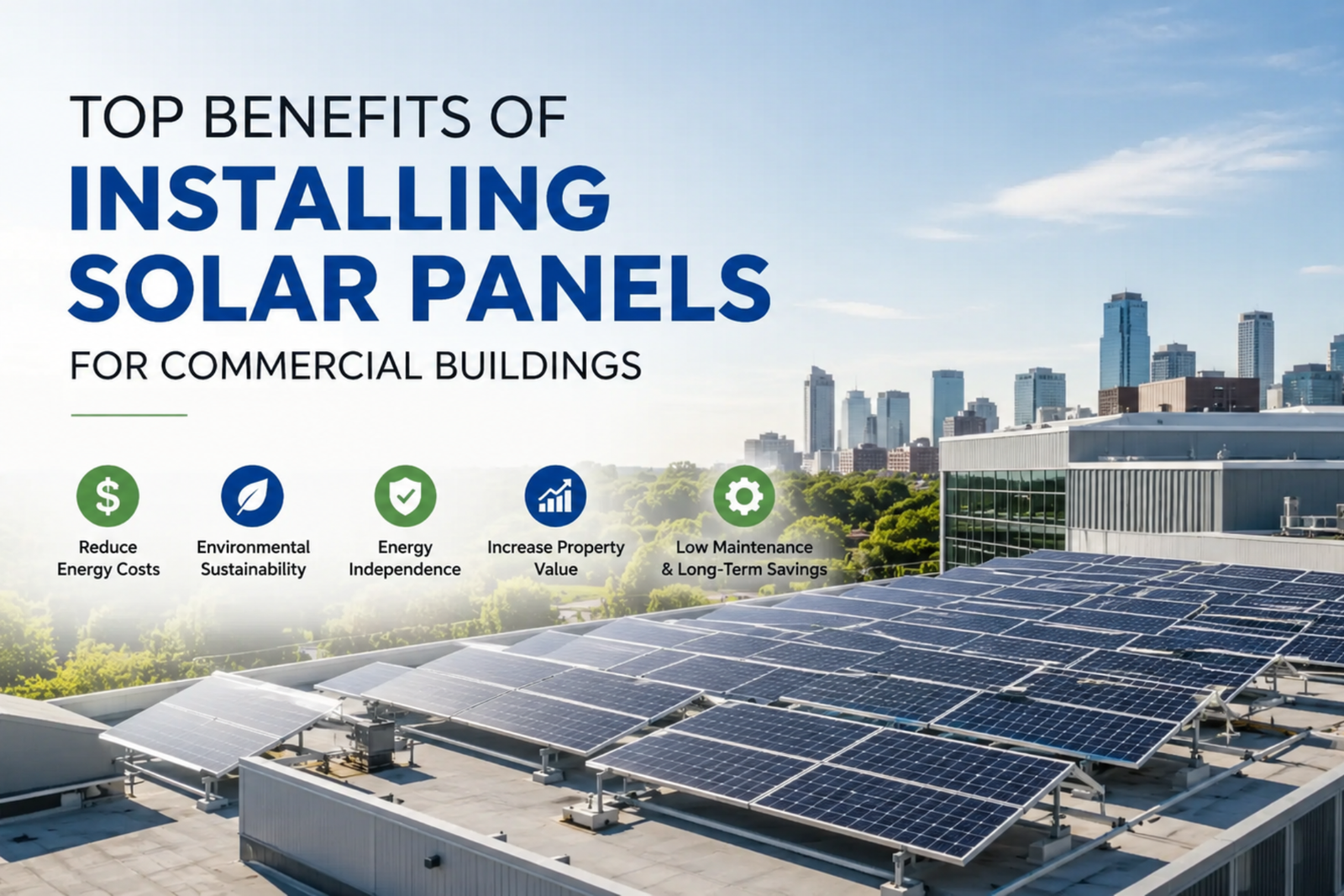
Installing solar panels on a commercial building can reduce electricity bills by 50–90%, offer a payback period of 4–7 years in India, and qualify your business for government incentives like accelerated depreciation and net metering. Whether you own a factory, office complex, or warehouse, commercial solar panels pay back far more than their upfront cost over a 25-year system life.
Why Are Businesses Switching to Solar Right Now?
The short answer: electricity costs in India have been climbing steadily, and businesses are feeling it more than anyone else. Commercial and industrial consumers pay among the highest per-unit tariffs because they don’t benefit from the subsidies that residential users receive. When a factory spends Rs. 8–12 per unit from the grid, even a modest 100 kW rooftop system can save Rs. 10–15 lakh annually.
That math is why solar energy for commercial buildings has moved from “nice to have” to a boardroom-level financial decision. And it’s not just about saving money. Clients, investors, and regulatory bodies are increasingly asking businesses to account for their carbon footprint. Solar gives you a concrete, measurable answer.
What Does Commercial Solar Installation Actually Involve?
A lot of people assume it’s just panels on a roof. The reality is more structured than that.
Commercial solar installation follows an EPC model: Engineering, Procurement, and Construction. A qualified team first assesses your rooftop area, structural load capacity, shadow analysis, sanctioned load, and grid connectivity. Then they design a system sized exactly to your consumption pattern, not a generic off-the-shelf solution.
The procurement stage involves sourcing panels, inverters, mounting structures, and cables that carry BIS and ALMM (Approved List of Models and Manufacturers) certification. This matters more than most buyers realise. ALMM-listed panels are the only ones eligible for government subsidies and many state-level net metering approvals. Using uncertified panels might save a few rupees per watt at purchase and cost you the entire incentive stack.
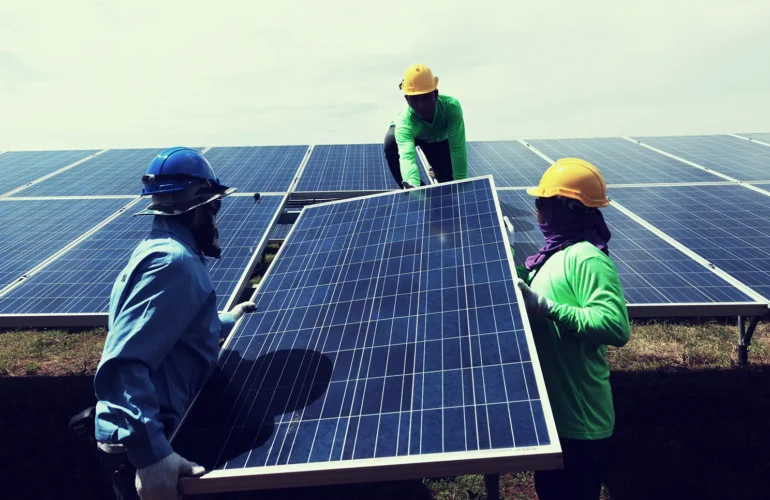
Construction covers structural mounting, DC and AC wiring, inverter installation, metering setup, and grid synchronisation. A professional commercial solar company handles all DISCOM approvals and net metering applications on your behalf, which can be the most time-consuming part of the process.
How Much Can a Business Actually Save?
Let’s put real numbers on it.
A 200 kW rooftop system on a commercial building in central India generates approximately 2.7–3.0 lakh units of electricity annually, based on an average of 5.5 peak sun hours per day. At Rs. 9 per unit (a conservative commercial tariff), that’s Rs. 24–27 lakh in annual savings.
System cost for a 200 kW commercial solar panel installation typically ranges between Rs. 70–90 lakh depending on panel type, structure complexity, and inverter brand. With a 40% accelerated depreciation benefit under Section 32 of the Income Tax Act, the effective first-year tax saving alone can be Rs. 8–12 lakh for a profitable business. That’s before you even count a single unit of generated power.
Payback periods in India typically land between 4 and 7 years for commercial installations. After that, you’re generating essentially free electricity for the remaining 18–20 years of the system’s life.
What Government Benefits Can Your Business Claim?
This is where many business owners leave money on the table because the incentive landscape is genuinely layered.
Accelerated Depreciation (AD): Businesses can claim 40% depreciation in the first year under the Income Tax Act. For a Rs. 80 lakh system, this translates to Rs. 32 lakh in depreciable value, potentially saving Rs. 10–11 lakh in taxes at a 34% effective tax rate.
Net Metering: Most states allow commercial consumers to export surplus solar power to the grid and receive credit on their electricity bills. If your business generates more power on weekends or during low-consumption periods, those units bank against future consumption.
PM-KUSUM Scheme: Primarily for agricultural and decentralised installations, but relevant for businesses with rural operations or ancillary agricultural land use.
GST Input Credit: Businesses registered under GST can claim input tax credit on GST paid during commercial solar systems procurement, further reducing the effective cost.
Why Is Rooftop Solar the Right Choice for Most Commercial Buildings?
Ground-mounted solar needs land. Most commercial buildings already have flat concrete rooftops sitting unused, effectively wasting real estate that generates no return. Commercial rooftop solar converts that dead space into an active revenue asset.
There’s also the operational angle. A rooftop system generates power at the point of consumption, which means you avoid transmission and distribution losses that typically add 20–30% to grid electricity costs. What the grid delivers to your meter has already lost a portion of its value in transmission. Solar power generated on your roof reaches your equipment directly.
For warehouse and manufacturing facilities, an insulated solar mounting structure can also reduce internal building temperatures by 3–5 degrees Celsius by shading the roof surface. In industries where air conditioning is a major cost, this secondary thermal benefit is genuinely significant.
How Does Industrial Solar Installation Differ from Standard Commercial Projects?
Industrial solar installation operates at a different scale and with a different set of engineering considerations.
Industrial customers typically consume between 500 kW and several MW of power, operate heavy equipment with high inductive loads and have strict power quality requirements. In a solar system for a textile mill, steel fabricator or pharmaceutical plant, the harmonic distortion, reactive power compensation and the interaction between solar inverters and large motor loads have to be considered.
That’s why experienced EPC companies perform detailed load flow analysis before finalising industrial solar designs. They also use hybrid inverter systems or battery storage where the industrial process cannot tolerate grid outages or frequency fluctuations.
Banking arrangements under state electricity regulatory commissions are also common in industrial solar installation projects, where the business can bank the units generated month on month and adjust them against the consumption during low-generation periods such as the monsoon months.
Are Solar Panels for Business a Good Fit for Every Type of Commercial Building?
Ideal candidates:
- Buildings with at least 1,000 sq ft of unshaded rooftop space
- Businesses operating during daylight hours (manufacturing, offices, retail)
- Organizations with monthly electricity bills above Rs. 50,000
- Properties with strong rooftop structure (RCC preferred over sheet metal)
Situations that need additional planning:
- Heritage or heritage-adjacent buildings where structural modifications face restrictions
- Buildings with heavy rooftop equipment (HVAC units and water tanks) that limit panel placement
- Industrial units on rented premises where lease tenure may be shorter than payback period
For leased premises, a Power Purchase Agreement (PPA) model works well. A third-party developer installs and owns the system; you purchase solar power at a pre-agreed rate lower than the grid tariff. Zero upfront investment, immediate savings.
What Should You Look for in a Commercial Solar Company?
The solar industry in India has grown fast, which means quality varies widely between installers.
A credible commercial solar company will:
- Use only ALMM-listed panels from Tier 1 manufacturers
- Provide detailed shadow analysis and energy yield reports before quoting
- Carry out structural load calculations and share them with the client
- Handle all DISCOM and net metering documentation
- Offer a minimum 5-year workmanship warranty separate from product warranties
- Have a functioning Operations & Maintenance arm for post-installation support
Ask for references from completed commercial projects of similar size. Visit those sites if possible. The quality of cable management, earthing systems, and junction box placement reveals far more about workmanship than any brochure does.
What Are the Best Business Solar Solutions for Long-Term ROI?
The highest ROI solar configurations for commercial buildings generally combine on-grid rooftop systems with net metering and accelerated depreciation benefits. For businesses with critical power needs, adding a Battery Energy Storage System (BESS) creates a hybrid setup that provides backup power during outages while still exporting surplus to the grid.
Business solar solutions with IoT-based remote monitoring platforms add another layer of value. Real-time performance tracking lets facility managers catch underperformance early. A string that’s generating 15% below forecast might indicate bird droppings, a shading issue, or a faulty module. Catching this in week two instead of year three is the difference between minor cleaning and a significant yield loss.
Corporate solar panels with monitoring integration also generate ESG-reportable data: generation in kWh, CO₂ avoided, equivalent trees planted. These numbers feed directly into sustainability reports, CSR disclosures, and green building certifications like LEED or GRIHA.
FAQs
Q1. How long do commercial solar panels last?
Quality panels from Tier 1 manufacturers carry a 25-year linear power output warranty, typically guaranteeing 80% or better output at year 25. Inverters generally have 5–10 year warranties and may need replacement once during the system’s life. The panels themselves routinely outlast their warranty period.
Q2. What happens to solar production during monsoon or cloudy days?
Output drops but doesn’t stop. On heavily overcast days, a well-designed system typically produces 15–25% of its peak capacity. Net metering compensates for this by allowing you to bank surplus units generated during high-production months against deficit months. Over a full year, the averages work in your favour.
Q3. Does solar affect our building’s insurance or structural integrity?
A properly engineered installation has no negative impact on structural integrity. In fact, panels protect the roof membrane from UV degradation and extend its life. You should inform your insurer about the installation. Most commercial property insurers include rooftop solar under standard coverage, though some require a rider.
Q4. Can we install solar if our building is on a lease?
Yes, through a PPA or lease arrangement where a developer installs and owns the system. You buy power at below-grid rates. Alternatively, if the lease has enough tenure (typically 10+ years), many businesses proceed with ownership after securing an NOC from the landlord.
Q5. How do I size the right system for my business?
Start with your last 12 months of electricity bills. A good EPC partner will analyse your load curve, peak demand hours, and available rooftop area to recommend a system that maximises self-consumption while staying within your sanctioned load. Oversizing beyond your consumption is rarely beneficial under most state net metering policies for commercial consumers.