
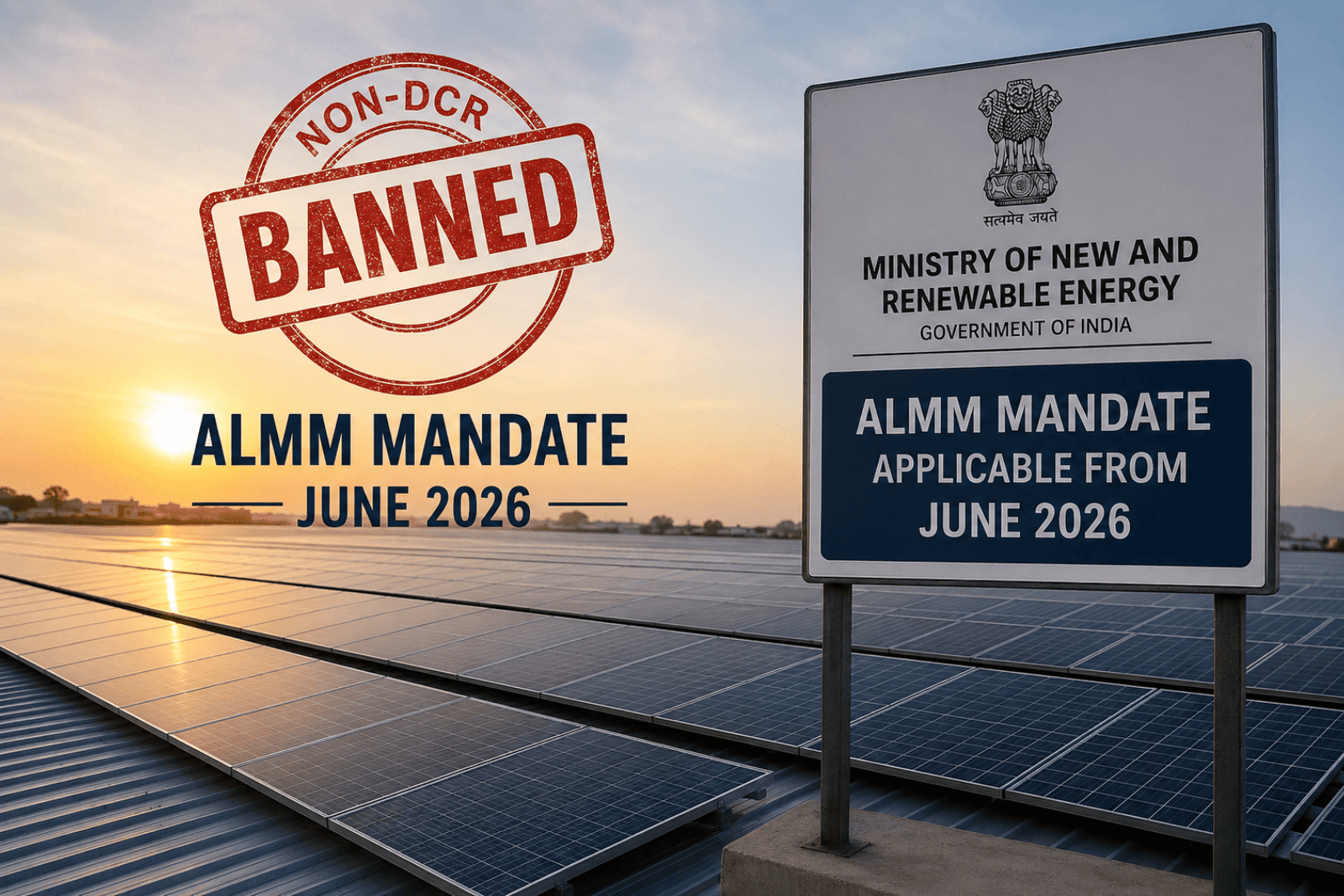
From 1st June 2026, all net metering and open-access solar projects commissioned on or after that date must use solar modules from ALMM List-I and solar cells from ALMM List-II, which means domestically manufactured cells only. If your project falls under a government scheme like PM Surya Ghar, PM KUSUM, or net metering, installing non-DCR panels now puts your subsidy, grid approval, and commissioning at serious risk.
What Exactly Did MNRE Ban on June 1st?
The confusion is understandable. WhatsApp groups and YouTube channels have been saying “non-DCR panels will be banned” since late 2025. Some of that is accurate. Most of it is incomplete.
The Ministry of New and Renewable Energy (MNRE) has ruled out a blanket extension of the June 1, 2026 ALMM List-II compliance deadline for solar cells while allowing project-specific exemptions for net metering and open access projects that had achieved substantial progress before the cutoff date.
From June 1, 2026, solar modules used in government-linked projects, PM Surya Ghar, PM KUSUM, open access, and net-metered installations must use cells from ALMM List-II, which means domestically manufactured solar cells only. This is not a blanket nationwide ban on all non-DCR panels. Purely private commercial or industrial installations with no subsidy or government scheme connection are currently not covered.
So to be precise: it is not a universal ban. It is a mandatory compliance rule for specific categories of projects. But those categories cover most of what homeowners, EPCs, and developers are actually building right now.
What Is a DCR Solar Panel and Why Does the Cell Matter?
DCR stands for Domestic Content Requirement. A DCR solar panel is one where both the solar cells and the module assembly are manufactured within India, under MNRE guidelines.
Here is where most buyers get misled: A panel can carry an Indian brand name, be assembled in an Indian factory, and still be non-DCR because the solar cells inside were imported. The key distinction under the June 2026 mandate is not where the module is assembled. It is where the cell inside it was made.
This one fact changes everything. You might be looking at a panel with an Indian company’s name on it, buying it from a local dealer, and it could still fail ALMM List-II compliance because the cells came from China, Vietnam, or Taiwan.
ALMM stands for Approved List of Models and Manufacturers. While ALMM List-I has governed solar modules since its introduction, List-II goes one level deeper by regulating the solar PV cells inside those modules. The goal is to build a fully integrated domestic solar manufacturing ecosystem in India, not just an assembly industry that depends on imported cell components.
The first ALMM List-II for solar PV cells was issued on 31st July 2025 and is being updated regularly. By 30th April 2026, it had already gone through seven revisions, with the enlisted manufacturing capacity exceeding 30 GW per year. A supplier who was not on the list in November 2025 may be listed now, and the reverse is also true. Always verify current status before procurement.
Which Projects Are Actually Affected?
If your project falls into any of these categories and is commissioning on or after June 1, 2026, you must comply with ALMM List-II:
- Net-metering projects (residential and commercial rooftops connected to the grid)
- Open access renewable energy projects
- Government-backed schemes: PM Surya Ghar Muft Bijli Yojana, PM KUSUM (A, B, C components)
- CPSU projects and government building installations
- Projects where bids were submitted after 9th December 2024
Projects whose last date of bid submission fell on or before 9th December 2024 were exempted from List-II requirements regardless of their commissioning date.
Key Insight for DS Group Solar Clients: Net metering is now directly tied to ALMM compliance. When your rooftop system sends extra units to the grid during the day and draws them back at night (banking units), that net-metering connection requires your panels to meet the new cell-level standards. Installing non-compliant panels means your net-metering application could get stuck at the DISCOM level.
Who Can Still Use Non-DCR Panels?
ALMM List-II becomes mandatory for most projects commissioned on or after June 1, 2026. This is not a blanket ban on non-DCR panels in all contexts.
Non-DCR panels remain permitted for:
- Purely private commercial or industrial installations with zero subsidy involvement
- Captive projects not linked to any government scheme or tender
- Projects whose bids were submitted on or before 9th December 2024
But a word of practical caution: Even in private C&I scenarios, many financing partners and large customers align procurement with government standards to reduce risk. A non-DCR plant today may face complications in future refinancing or if policy tightens further. The trajectory is clear and moving one direction only.
What Are the Exemptions Under the May 2026 MNRE Memorandum?
The May 25, 2026, office memorandum introduced a case-by-case exemption structure for projects genuinely caught mid-construction. There are two categories:
Category I: Projects in which 100% of the required solar modules were installed at the project site before June 1, 2026, but the project was not commissioned before that date. These must provide approval/certification from the DC-side authorities, including installation certification.
Category II: Projects that had taken “effective steps” before the deadline. Under Category II, projects that had undertaken effective steps before the deadline must satisfy multiple conditions simultaneously to qualify. These include possession of at least 75 per cent of project land before June 1, 2026; achievement of financial closure; grant of in-principle connectivity; and approval of electrical drawings before May 1, 2026. Additionally, modules must have either arrived at the project site or more than 50% must have been installed.
Submitting a Claim: All exemption claims must be submitted through the online portal at solardcrportal.nise.res.in by 30th June 2026. No physical applications will be accepted. An expert committee will review each claim individually.
The ALMM framework has been introduced to strengthen India’s domestic solar manufacturing ecosystem and reduce dependence on imported solar cells and modules. Industry experts believe the decision balances regulatory certainty with practical flexibility for ongoing projects.
DCR vs Non-DCR: The Real Cost Comparison
One objection we hear from clients often: “DCR panels are too expensive.” Let us look at actual numbers.
As of late 2025 and early 2026 market estimates, DCR panels typically ranged between ₹23 and ₹28 per Wp, while imported-cell or non-DCR panels were often available in the ₹8 to ₹15 per Wp range. Actual pricing varies significantly based on technology, project size, manufacturer, procurement volume, and market conditions.
On paper, non-DCR looks cheaper. But factor in subsidies:
For illustration, a typical 3kW rooftop solar system may cost around ₹1.8 lakh before subsidy. After the current PM Surya Ghar subsidy of up to ₹78,000, the effective cost may reduce substantially. Actual system pricing varies by state, installer, component selection, and installation conditions. DCR panels with subsidies offer a payback period of typically 1 to 2 years. Non-DCR panels without subsidies may extend the payback period beyond 3 to 4 years.
The numbers make the decision clear for any residential rooftop buyer or small business owner going through PM Surya Ghar. The subsidy alone makes DCR the smarter choice.
What Comes After June 2026?
India’s push for a fully domestic solar supply chain does not stop at List-II. The government has extended the ALMM framework to cover solar ingots and wafers, with ALMM List-III coming into effect from 1st June 2028. This means the next two years will see further tightening of what qualifies as a truly “Made in India” solar system.
For anyone procuring panels today with a 25-year view, buying from manufacturers with full vertical integration, from cells to modules, is the most future-proof decision.
PM Surya Ghar Scheme: Still Running Strong
For homeowners worried about timing, the scheme continues. Residential consumers can opt for the “Give It Up” option for Central Financial Assistance (CFA) under the PM Surya Ghar scheme, which continues till 31st March 2027.
You still have time to install a compliant system, claim your subsidy, and benefit from net metering. But the window for procuring non-ALMM-listed panels under subsidy schemes has effectively closed.
FAQ
How do I know if a panel is DCR-compliant and on ALMM List-II?
Check the MNRE website at mnre.gov.in for the current ALMM List-II. Additionally, MNRE has amended the ALMM order to require a unique 16-digit certificate for every DCR module. This traceability requirement, managed through the national DCR Verification Portal operated by the National Institute of Solar Energy, is now the exclusive mechanism for DCR verification. Ask your supplier for this certificate before placing any order.
My solar project was under construction before June 2026. Am I affected?
Potentially no, if you meet the exemption criteria. Apply for a case-by-case exemption through the DCR portal before 30th June 2026 with your supporting documents. If your modules were 100% installed on site before June 1, you qualify under Category I.
Does ALMM List-II affect my existing rooftop solar system that is already commissioned?
No. The mandate applies only to projects commissioned on or after June 1, 2026. Systems already running under net metering are not affected.
Which Indian manufacturers are approved under ALMM List-II?
The first ALMM List-II was published on 31st July 2025 with nine manufacturers and a combined enlisted capacity exceeding 13 GW per year. The list has been revised six times since then. Major names include Adani, Waaree, and Vikram Solar. Always cross-check the current revision on MNRE's official website, as manufacturers are added and removed with each update.